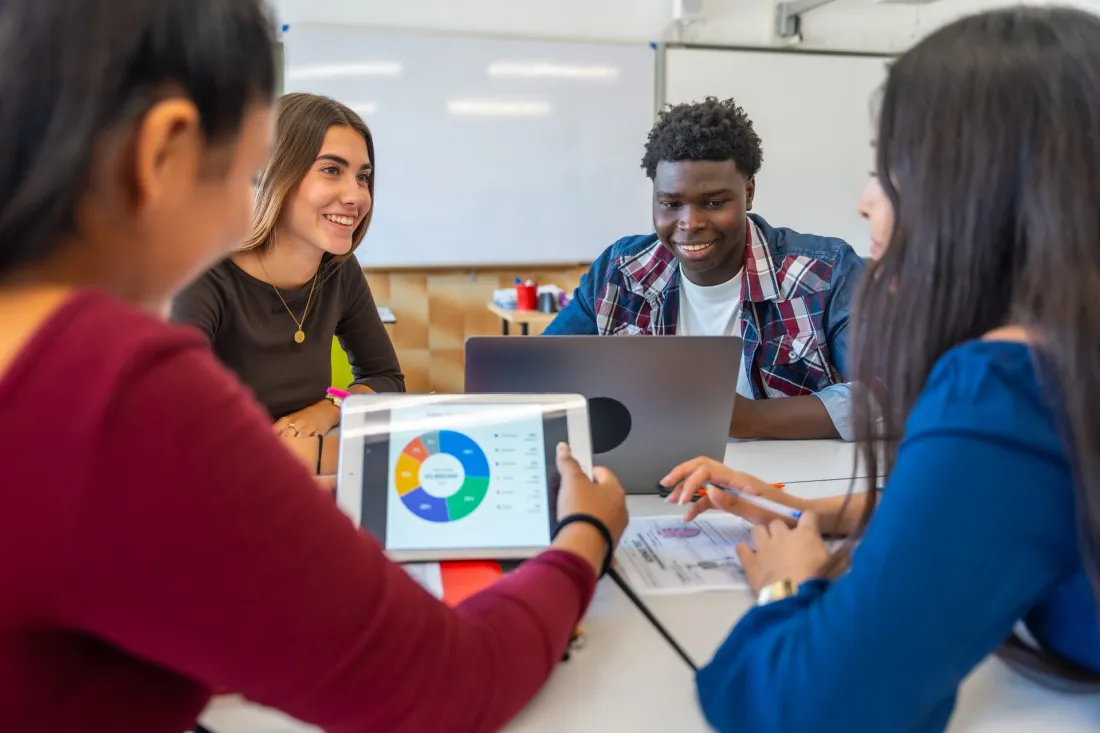
International Economics at the Faculty of Economic Sciences of the University of Warsaw is a two-year master’s programme taught entirely in English. It combines advanced micro- and macroeconomics with international finance, trade policy, econometrics and negotiation, in a class where most students come from abroad, and it prepares graduates for international institutions, banks, business or doctoral studies — and at the end you can check whether this degree suits you.
International Economics is a two-year master’s programme run by the Faculty of Economic Sciences at the University of Warsaw. It is conducted in English, offered as full-time daytime studies, and leads to a master’s degree. Its main goal is to give students advanced knowledge of international economics that the faculty describes as comparable to master’s programmes at the best universities in the European Union.
The programme serves two kinds of students. For some, it is a theoretical foundation for doctoral studies in economics, in Poland or abroad. For others, it is preparation for work in international institutions dealing with economic issues, in the national public sector or in international business.
According to the faculty, students of International Economics will:
The list of graduate competencies shows how broad the programme is. Graduates are expected to understand international financial and currency markets and the valuation of financial instruments. They learn the latest patterns of international trade, including technology transfer in the global knowledge economy, and how to analyse developments in the world economy, trade trends and trade policy.
The programme also covers agglomeration and deglomeration processes, including flows of foreign investment, analysed with models of economic geography, as well as international population and labour migration. Students get to know international economic, trade and financial organisations and the rules for negotiating and settling commercial disputes.
Strong quantitative skills are at the heart of the degree. Graduates should be able to use mathematics, advanced statistical and econometric methods and analytical software to examine economic, financial and management problems. Just as important are soft skills: conducting business negotiations, presenting the results of analyses and handling business correspondence in fluent English. The programme also stresses the need to follow professional ethical standards.
Most students on the programme are international students, so everyday study takes place in a genuinely international environment. At the end of the first year, students can apply for a double-degree track run under a bilateral agreement with a partner university in Germany, the University of Trier. In that case the second year takes place at the partner university, and after meeting the requirements a student can receive a diploma from the University of Warsaw and a master’s degree from the partner institution.
The programme is open to holders of a bachelor’s, engineer’s, master’s or equivalent diploma in any field. Candidates need to prove English at least at B2 level. A background in economics, mathematics, finance or programming can count in the admission process, and candidates may add an optional letter describing their research experience. Current admission rules and fees are best checked on the faculty website, as they may differ between intakes.
Graduates are prepared to work in international institutions such as the World Bank or the IMF, in international banks and in private companies active on international markets. The faculty also points out that the programme provides good analytical preparation for research on the international economy.
International Economics at the University of Warsaw is a two-year, English-taught master’s programme that combines advanced economic theory with international finance, trade, migration and econometrics. It suits analytically minded students who want to work in international institutions, banks or global business, or to continue towards a PhD, and who enjoy studying in an international group.
10 questions · two minutes



 EN

 CS
 DE
 ES
 FR
 HU
 IT
 PL
 PT
 РУ
 SK
 TR
 УК
 AR
 中文