
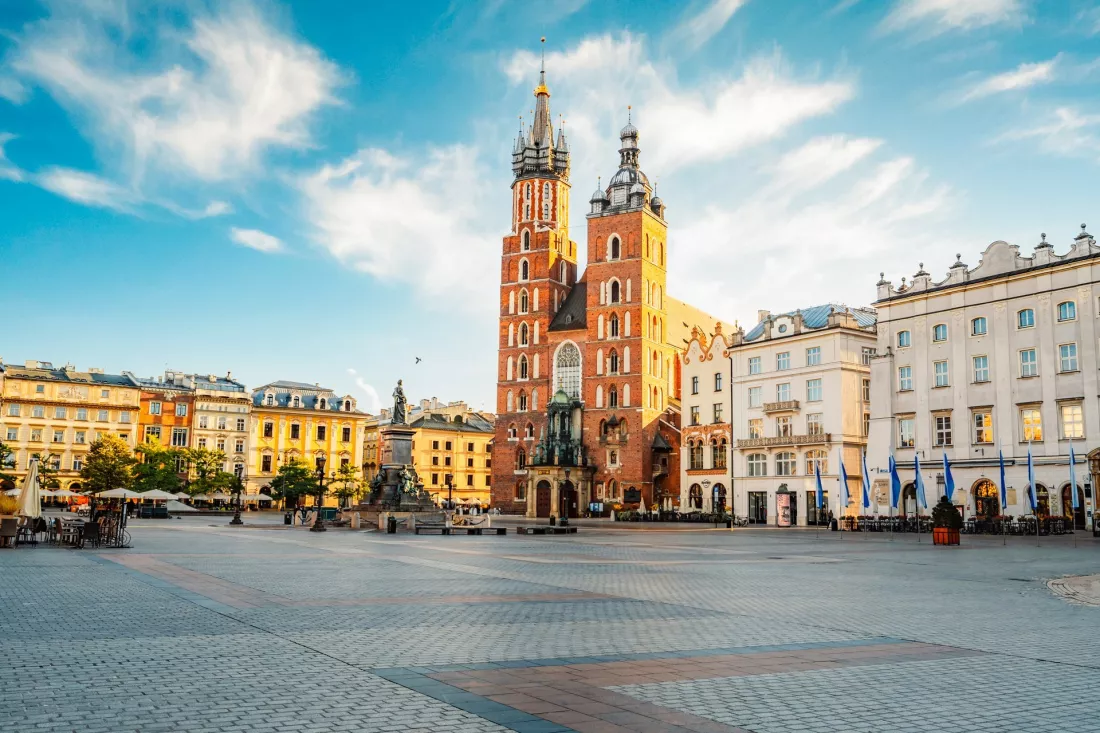
Why do some regions grow while others stall, how do migration, trade and media connect places that seem far apart, and who actually governs a globalised world? Global and Development Studies at the Jagiellonian University in Kraków is a three-year bachelor programme taught entirely in English that tackles these questions through politics, economics, law, history and culture — and at the end you can check whether this global perspective is the right fit for you.
Global and Development Studies (GLAD) is a first-cycle programme run by the Faculty of International and Political Studies of the Jagiellonian University. It aims to give students an in-depth understanding of globalisation in many spheres of human activity: law, politics, economy, history, social relations, culture and communication.
Students gain core knowledge of globalisation and international development, and then specialise in the aspects that interest them most. The programme lets them focus either on a selected part of the world or on specific global problems and challenges.
The Faculty of International and Political Studies describes itself as the most international and interdisciplinary unit at the university. Its expertise goes beyond traditional politics and international relations to humanitarian aid, environmental protection, public health, media and communication. Different units at the faculty specialise in particular regions of the world, which helps link global phenomena to concrete places.
The faculty is based in a modern building near the Jagiellonian Library, close to Błonia and Jordan Park. It has auditoriums, seminar rooms, a student zone and a departmental library with a reading room.
The first two semesters build a broad base. Compulsory courses include World History and Politics, Introduction to Philosophy, Society in the Era of Globalization, Globalization and Global Governance, World Geography, Geopolitics, Contemporary International Relations, Global Economy and World Legal Systems. Academic English courses focus on research, presentation and writing skills.
In the second year the focus shifts to how societies change. Students take courses such as:
Research methods and a foreign language are also part of the schedule.
The final year covers World Religions, Transnational Migrations, Contemporary Parties and Ideologies, World Cultural Heritage, Urbanization and Development, Globalism, Regionalisms and Separatisms, and Health, Food and Environment. Students write their bachelor thesis in a two-part seminar. Elective courses run through all six semesters, so each student can shape their own profile.
The programme suits people who follow world news and want to understand what lies behind it, who are curious about other cultures and comfortable studying in English. It rewards those who like connecting facts from different fields — economics with history, law with culture — rather than staying in one box.
Students can join research societies and student organisations, including the Association of International and Area Studies. Those interested in studying abroad can use Erasmus+, CEEPUS, the Utrecht Network, bilateral agreements or the European university alliance Una Europa.
Graduates know the main traditional and contemporary trends in global sociology, philosophy, politics and economy. They are prepared to work in public administration, national and international institutions and organisations, non-governmental organisations, international companies, cultural institutions, media and publishing. The programme is also a first step towards a master's degree in international relations, area studies, political science or economics — for example International Security and Development at the same faculty. Current admission rules are best checked in the university's online application system, as they differ between recruitment rounds.
Global and Development Studies at the Jagiellonian University is an English-taught bachelor programme for people who want to understand globalisation from many angles. Over three years it combines history, geopolitics, economics, law, human rights, migration and culture, with plenty of electives. It opens the way to careers in international organisations, NGOs, business, media and public administration, or to further study.

10 questions · two minutes



 EN
EN 
 CS
CS DE
DE ES
ES FR
FR HU
HU IT
IT PL
PL PT
PT РУ
РУ SK
SK TR
TR УК
УК AR
AR 中文
中文