
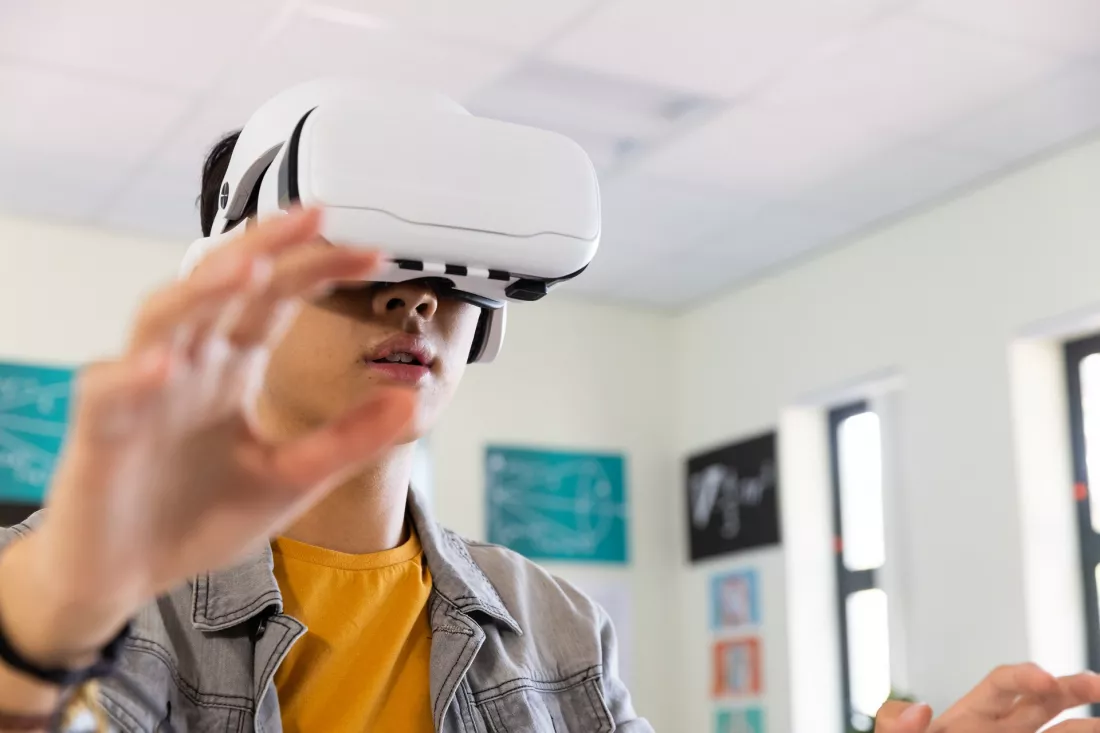
A game you play with your whole body, a training simulator a surgeon puts on like a pair of glasses, a museum room that exists only in software — all of them come out of the same kind of team. At PJAIT, computer science students in English can make that work their own area of study: extended reality, immersive games and systems. Here is what really happens inside that area, what its graduates end up doing, and a short test that will tell you whether you belong there.
The area is run by the university's XR research and development centre, and the syllabus reads like the production plan of a real studio: market and user research, concept design, rapid prototyping, then software and content development, and finally the teamwork and documentation habits that keep a long project alive. Not one skill, then, but the whole chain that turns a sketch into something a person can put on their head and walk around in.
The diploma splits in two. The core track, game development, points towards production: designing mechanics, building them in an engine, testing them on players. The extended track, XR research and development, points towards the laboratory: immersive systems treated as a research subject, with psychophysiological data, machine learning and interface experiments. Both live inside the same area, and the choice tends to follow temperament — whether you would rather ship a build or measure what it does to the person wearing it.
Unity and Unreal are the working environments, C# is the language that appears most often, and the specialised courses carry names that say exactly what they are: participatory game design, and Unity taken seriously — design patterns and development practices rather than a tutorial. Alongside that comes 2D and 3D content: modelling, texturing, animation, the technical preparation of assets. A person who can only code will sooner or later wait for someone who can only draw, which is precisely why this area refuses to separate the two.
Immersion stops being a metaphor once the input stops being a gamepad. The teaching reaches towards voice control, eye tracking and brain-computer interfaces, and combines them with machine learning. This is the part that most often surprises candidates: a large share of the work is not about rendering a prettier world, but about reading a signal from a human being and deciding what the system should do with it.
From the game development track the titles are familiar from studio credits: game designer, game developer, Unity developer, 2D and 3D artist, sound designer. From the research track the road leads towards immersive systems built for someone other than a player — training, therapy, simulation, cultural institutions — and towards teams that analyse the data collected while the headset is on. Both roads pass through a portfolio; in this industry a finished, playable thing weighs more than a grade.
Studying at PJAIT in English means that the whole chain — lectures, documentation, engine manuals, team communication — runs in one language. The area itself is chosen in the second year of full-time studies, so the first year is a general computer science foundation: mathematics, algorithms, programming. Candidates who love games but dislike that foundation tend to find out quickly. Those who treat it as the price of admission usually stay, and later say it was the part that made the rest possible.
Extended reality, immersive games and systems suits people who want to build experiences rather than only applications, and who are willing to work across code, content and human perception at the same time. It offers a production track and a research track, engines and psychophysiology, a portfolio and a laboratory. The test below will not decide anything for you, but it will show fairly quickly which of those two rooms you would rather be sitting in.

10 questions · two minutes


 EN
EN 
 CS
CS DE
DE ES
ES FR
FR HU
HU IT
IT PL
PL PT
PT РУ
РУ SK
SK TR
TR УК
УК AR
AR 中文
中文