Leadership and Statecraft is a two-year, English-taught master’s specialisation within International Relations at Lazarski University in Warsaw. Students examine how power is exercised, how political strategies take shape and how decision-making institutions work, then practise it in debates, policy simulations and team projects. Internships in embassies, government agencies and think tanks point towards diplomacy, public policy and security — and at the end you can check whether this path is right for you.
Leadership and Statecraft is a specialisation within the International Relations programme at Lazarski University in Warsaw. It is a full-time master’s degree that lasts two years and is taught entirely in English. The programme is aimed at people who see themselves in leading roles in diplomacy, government or international organisations. Its tagline says that leadership is no longer a choice but a responsibility, and the curriculum is built around that idea.
Instead of treating politics only as theory, the programme looks at how things work in practice. Students study how power is exercised, how political strategies are formed and how key institutions reach decisions. The approach draws on political science, diplomacy and public policy, so the same topic is seen from several angles. The structure is flexible, which makes it possible to combine studies with work or other responsibilities.
The programme is organised around four areas of learning. Each of them combines analysis with skills that are useful in real institutions, from ministries to international bodies.
The first semester lays the groundwork. Students take Fundamentals of Politics with advanced analysis, Globalisation and Regionalisation, Energy Security and Sustainable Development, and MA Advanced English. The second semester moves towards the discipline itself, with Theories of International Relations and Strategic Studies, Foundations of Geopolitics and Security Studies, and MA Research Methods in International Relations. Academic writing for the master’s level is part of the plan as well.
In the last semesters students choose seminars that go deeper into a single theme. The seminars mentioned in the programme description include leadership from the ancients to the moderns and a seminar on liberty, citizenship and the state. They also prepare students to pick a topic for their master’s thesis.
Fun fact: One of the seminars looks at leadership across the centuries, from the ancient world to modern times, so students compare today’s decision-makers with much older models of leading a state.
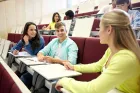
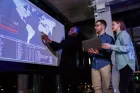
The programme stresses that students should not only study leadership but also try it. Classes use debates, policy simulations and collaborative projects, so participants regularly argue a position, negotiate a compromise or prepare a recommendation as a team. Groups are small, with personal mentoring and close contact with lecturers. The teachers are described as academic practitioners with international academic and professional experience.
Through this kind of work students develop team management, negotiation, public speaking, strategic thinking, decision-making under pressure and analytical thinking. These skills are useful far beyond politics, in any job where people have to explain a decision and defend it.
The programme offers several ways to gain experience outside regular classes. Students can do internships in embassies, government agencies, international organisations and leading think tanks. There are also student clubs where debating and negotiating become a hobby as well as a skill.
The programme speaks to people interested in global challenges such as security, economic inequality and migration. It also suits those who want to combine strategic thinking with leadership in political or business settings, and who like the idea of making decisions in high-stakes international environments. Graduates are prepared for roles such as diplomat, political advisor, government strategist, national security specialist, think tank analyst or international affairs consultant.
Studies take place in Warsaw’s Mokotów district, close to a metro station and tram and bus lines. The campus offers classrooms with interactive technology, a library and a gym. Current admission rules and fees are worth checking on the university’s admissions website, as they vary between intakes.
Leadership and Statecraft is a two-year master’s specialisation within International Relations, taught in English in Warsaw. It combines political theory, diplomacy and public policy with debates, simulations, internships and student clubs.
It fits students who want to work in diplomacy, government, security or international organisations and who learn best by doing. Small groups and flexible organisation make it realistic to study alongside other commitments.
10 questions · two minutes


 EN

 CS
 DE
 ES
 FR
 HU
 IT
 PL
 PT
 РУ
 SK
 TR
 УК
 AR
 中文