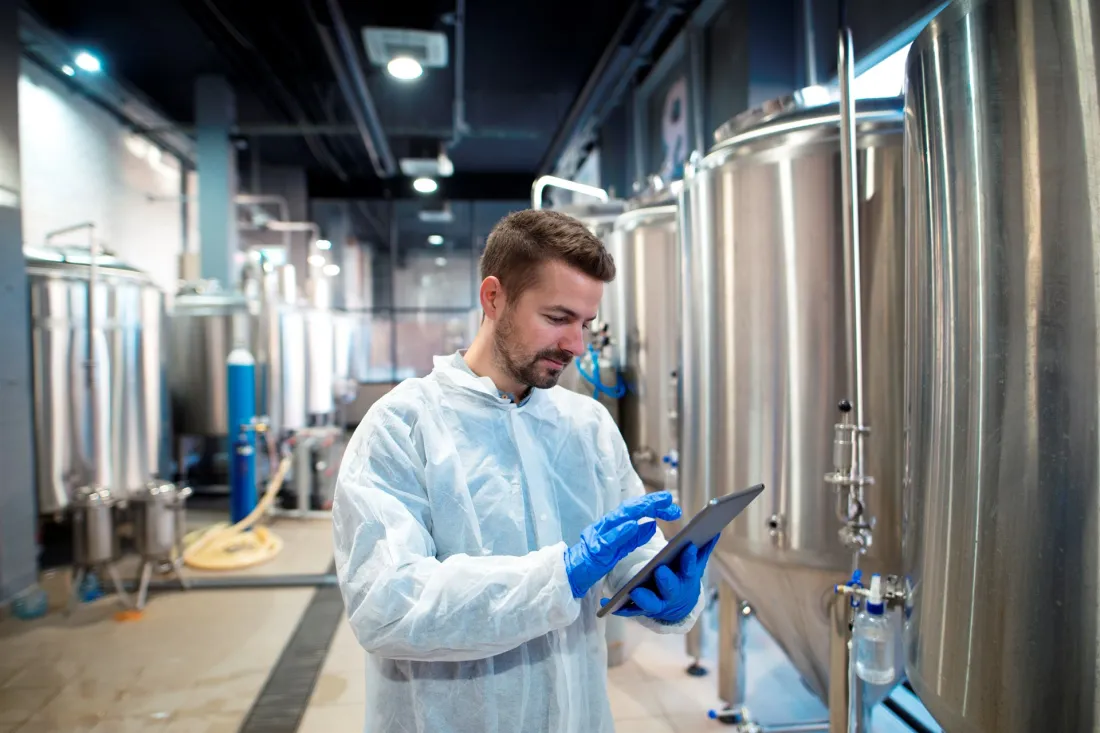
Every yoghurt, loaf of bread or plant-based snack on a shop shelf has passed through machines, laboratories and quality checks designed by engineers. The University of Warmia and Mazury in Olsztyn trains such specialists in Food Engineering, an English-taught master’s specialisation run together with a German university of applied sciences and ending with a double diploma — and at the end you can check whether food engineering is the right path for you.
Food Engineering is an English-taught specialisation of the second-cycle (master’s) programme Food Technology and Human Nutrition at the University of Warmia and Mazury in Olsztyn (UWM). It is run by the UWM Faculty of Food Science and lasts three semesters, or one and a half years. Graduates earn 90 ECTS credits, the degree of Master of Science in Engineering (M.Sc.Eng.) and a double diploma. All classes are taught in English, so the specialisation is open to both Polish and international students who want to work in the food industry.
The structure of the Food Engineering master’s at UWM is what makes it stand out. Students do not spend the whole programme in one place, but move between two partner universities and, if they wish, a company or a research centre. The plan looks like this:
Fun fact: although the Food Engineering master’s at the University of Warmia and Mazury in Olsztyn takes only three semesters, it ends with a double diploma, and the thesis does not have to be written at a university at all, as it can also be prepared at a company or a research institution.
The Food Engineering specialisation at UWM focuses on bioprocess engineering and food manufacturing systems. In practice, this means learning how raw materials are turned into safe, high-quality food on an industrial scale, and how such processes can be designed, controlled and improved. The main areas covered by the programme include:
Food Engineering at the University of Warmia and Mazury is not only about machines and laboratories. According to the graduate profile of Food Technology and Human Nutrition, students also learn about human nutrition and national nutrition policy, diet-related diseases, world dietary patterns, alternative diets and functional food additives. The programme covers hypoallergenic food, trends in raw materials and the rules of food labelling, including nutritional value and health claims.
There is also a strong business element. Graduates of the UWM master’s programme are expected to understand economics and company competitiveness well enough to help develop a company’s vision and strategy. They learn about quality management systems, food safety, environmental safety and workplace health and safety. The programme also touches on scientific ethics, copyright, patents and ergonomics, which matter when a food product goes from the lab to the market.
A Food Engineering graduate from UWM can run laboratory experiments, analyse bioactive compounds and process results with statistical software. They can design integrated management systems, carry out internal audits, select process equipment and prepare economic analyses. The graduate profile also mentions designing foods, supplements and dishes and developing product concepts. Writing technical reports and project documentation in a foreign language, usually English, is part of everyday training. Current admission rules and fees are worth checking on the university’s admissions website, as they vary between intakes.
Graduates of the Food Engineering specialisation at the University of Warmia and Mazury in Olsztyn are prepared to work as engineers and managers in food processing companies. They can also find jobs in enterprises that deal with food production, storage and distribution, and in quality control and management across the food industry. Other paths include research institutions and R&D centres, and the programme also prepares students for doctoral studies.
Food Engineering at UWM is a compact, three-semester master’s specialisation taught entirely in English, combining a semester in Olsztyn, a semester in Offenburg and a thesis that can be written at a university or in industry. It links engineering, microbiology, quality control, nutrition and business. It suits people with an engineering background who want to design and improve the way food is produced and who are keen on an international experience.
10 questions · two minutes


 EN

 CS
 DE
 ES
 FR
 HU
 IT
 PL
 PT
 РУ
 SK
 TR
 УК
 AR
 中文