

Częstochowa, Poland

Musical Arts Animation
(field of studies: Music in Public Space)

Bachelor's
Table of contents
3d-render-cartoon-characters-people-playing-music-musical-instruments

⇑Musical Arts Animation at UJD

Field of studies: Music in Public Space
Language: EnglishStudies in English
Subject area: arts
Kind of studies: full-time studies
  • Description:

  • pl
University website: www.en.ujd.edu.pl

⇑Why choose the Musical Arts Animation specialisation at UJD?

Dlaczego warto studiować na UJD
Why study it:

Musical Arts Animation is a specialisation within the Music in Public Space programme (first-cycle studies) at Jan Długosz University in Częstochowa. It is for you if you would rather organise musical life, from concerts to festivals, than build your future on stage performance alone.

Programme: management, projects and promotion

The specialist block is about running culture. You study the organisation and management of cultural institutions, the funding of music (sources of money, raising funds and settling the accounts of artistic projects) and the promotion and marketing of cultural goods.

In the course on artistic projects you go through the phases of preparing a project, from planning and anticipating needs to the types of events: concerts, performances, festivals and international projects, with a touch of advertising and public relations. A separate class on music agency covers the kinds of artistic events and the documents needed to carry one out.

Specialisation: what sets this path apart

Here you learn to speak about music, not only to play it: the programme includes music lecturing and music journalism, where you prepare concert introductions, talks for audiences of different ages and music reviews, along with piano, conducting, vocal and instrumental ensembles and a history of jazz and popular music.

Languages: studying in English

The programme is taught in English, so the classes on management, projects and music journalism are held in that language.

After graduation: what you can organise afterwards

You are prepared to work as a manager and animator of musical activity in institutions such as philharmonics, concert halls, cultural centres, bands and the media, and to take on tasks like:

  • organising festivals and competitions;
  • staging music events;
  • running training courses;
  • preparing workshops.

Based on the study plan and the UJD admissions page.
⇑Test: Is Musical Arts Animation the right fit for you?

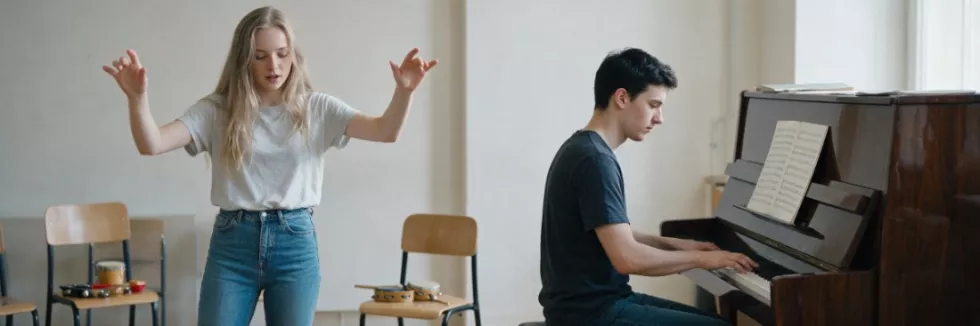
students-leading-a-music-workshop-at-a-piano

10 questions · two minutes

1. A local cultural centre asks you to run a music workshop for teenagers who have never played an instrument. How do you react?

2. How do you feel about leading a group – a choir, an ensemble or a music class?

3. You’re organising a concert series for seniors. What matters most to you?

4. Which task would you choose?

5. How do you feel about writing a funding application to support a music project?

6. The programme is taught in English, and you’ll run workshops with students from many countries. How do you feel about that?

7. During a workshop, a few participants are shy and refuse to sing. What do you do?

8. How do you feel about practising your own instrument or voice regularly, alongside organising and teaching?

9. Which future role sounds most like you?

10. What motivates you most to study Musical Arts Animation?

⇑Definitions and quotes

Animation
Animation is a dynamic medium in which images or objects are manipulated to appear as moving images. In traditional animation, images are drawn or painted by hand on transparent celluloid sheets to be photographed and exhibited on film. Today most animations are made with computer-generated imagery (CGI). Computer animation can be very detailed 3D animation, while 2D computer animation can be used for stylistic reasons, low bandwidth or faster real-time renderings. Other common animation methods apply a stop motion technique to two and three-dimensional objects like paper cutouts, puppets or clay figures. The stop motion technique where live actors are used as a frame-by-frame subject is known as pixilation.
Animation
Work hard. That’s the thing that most people who love games and animation may not realize about what they’re seeing. It requires an ugly amount of work. You have to dedicate your life to it, but I believe almost anyone can learn how to make games and animate at a competent level. I don’t believe in following your dreams and going into too much fairy dust about the arts. Sure, it’s fun, but there are many times it’s not fun and you still have to do it.
Doug TenNapel, "A Conversation with ‘Armikrog’/‘Earthworm Jim’ creator Doug TenNapel", Ben Mitchell, Skwigly: Online Animation Magazine, 30 September 2015
Animation
Animation in itself is an art form, and that's the point I think always needs clarification. True animation exists without any background, or any color, or any sound, or anything else; it exists in your hand. And you can take it and flip it. [...] What makes animation is the fact that you have a series of drawings that move. You don't even have to have a camera, you see; animation exists without it. If you want to broaden your audience, or make it more colorful or add music, then you put it under a camera one frame at a time, and then you run it at the same speed as you flip it, and then you have animation. If it depends basically upon soundtrack, or basically upon music, or color, graphic design, or anything else to sustain itself, then it is not unique to animation.
Chuck Jones Joe Adamson, Witty Birds and Well-Drawn Cats: An Interview with Chuck Jones [1971], in Chuck Jones: conversations, ed. Chuck Jones and Maureen Furniss (Univ. Press of Mississippi, 2005), 63.
Animation
Animation can explain whatever the mind of man can conceive. This facility makes it the most versatile and explicit means of communication yet devised for quick mass appreciation.
Walt Disney as quoted in OpenGL Shading Language (2006) by Randi J. Rost, p. 411

Contact:

Waszyngtona str. 4/8
42-200 Częstochowa
phone +48 34 378 41 00
StudentNews Group Websites for students and future students — in Poland since 2007, across Europe since 2014. Over 50 websites and millions of users a year (Google Analytics). Studies in Europe Universities in Europe Bachelor’s Master’s Doctorate MBA Study guide Work abroad Travel For partners Advertising and cooperation Reach (online report) Contact advertising@studentnews.eu © 2003–2026 Grupa StudentNews.pl sp. z o.o., Modlnica, Poland
Privacy Policy