

Częstochowa, Poland

Music in Public Space

Bachelor's
Table of contents
rear-view-man-standing-by-railing-against-building

⇑Music in Public Space at UJD

Language: EnglishStudies in English
Subject area: arts
Kind of studies: full-time studies
  • Description:

  • pl

⇑Why study Music in Public Space at UJD?

dlaczego-warto-studiowac-na-UJD
Why study it:

Music in Public Space at Jan Długosz University in Częstochowa (UJD) is a three-year Bachelor's programme (first-cycle) with a general academic profile, taught in English at the Faculty of Arts. It is meant for musicians who want both to develop as artists and to animate musical life – through concerts, events and projects of their own design.

Programme: theory, instruments and ensembles

Classes are held in small groups. You study the history of music, including jazz and popular music, train your auditory skills and learn harmony, the basics of composition, arranging and improvisation. You have individual contact with teachers of various instruments – for example piano, accordion, pipe organ, percussion, guitar and violin – and you also practise choir conducting and leading instrumental combos. Joint work of students and teachers results in solo performances, choir concerts and instrumental ensembles.

Specialisation: three specialties

You choose one of three specialties:

  • Instrumental Performance (piano, guitar, accordion, organ) – interpretation of classical music, playing in ensembles, the basics of voice technique and improvisation; it prepares you to perform as an instrumentalist or chamber musician,
  • Musical Arts Animation – managing cultural centres and a music agency, financing of culture, promotion and marketing of cultural goods, and organising festivals, competitions and workshops,
  • Stage Music (vocal studies, electric guitar, bass guitar, drum set) – a diverse vocal and instrumental repertoire, the basics of conducting, jazz harmony, improvisation and jazz arranging, plus stage movement and dance with choreographic elements.

Exchanges: guest professors and exchanges

The department works closely with the Częstochowa Philharmonic, other cultural institutions of the city and the region, and partner universities abroad. Professors from foreign institutions – including Ukraine, Slovakia, Lithuania, Germany and the USA – often come to teach classes with students. Students of the programme regularly take part in international exchange programmes.

After graduation: culture institutions and the stage

You can work in cultural centres, institutions and offices, including philharmonics, concert halls, music bands and the media, organise musical life in both big and small towns, perform as a musician, or continue with second-cycle studies.

As of the 2026/27 admissions, based on the programme description at rekrutacja.ujd.edu.pl.
⇑Test: Is Music in Public Space the right fit for you?

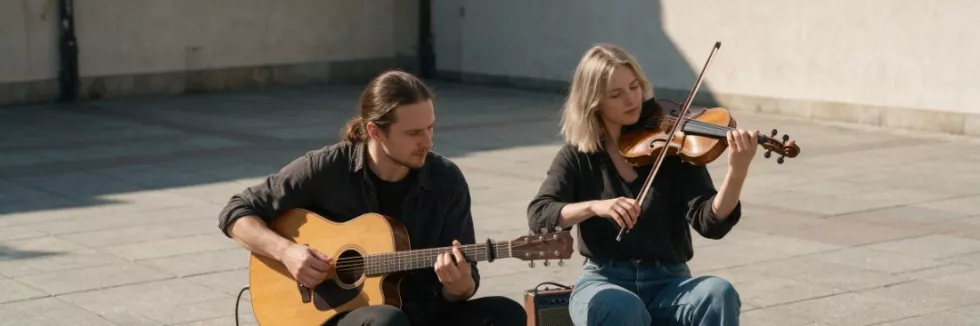
music-students-playing-guitar-and-violin-in-a-city-square

10 questions · two minutes

1. You’re asked to plan a free open-air concert in a park. Where do you start?

2. How do you feel about music being played in streets, squares, stations and other public places?

3. Local residents complain about noise from a summer music event. How do you respond?

4. Which project would you choose?

5. How do you feel about working with people who are not professional musicians – such as a community choir or a neighbourhood drumming workshop?

6. The programme is taught in English, and you’ll create projects with students from many countries. How do you feel about that?

7. How do you feel about the practical side of outdoor music – portable sound systems, power, weather and acoustics?

8. A city wants to make a neglected square more lively. What could you suggest?

9. Which future role sounds most like you?

10. What motivates you most to study Music in Public Space?

⇑Definitions and quotes

Music
Music is an art form and cultural activity whose medium is sound organized in time. The common elements of music are pitch (which governs melody and harmony), rhythm (and its associated concepts tempo, meter, and articulation), dynamics (loudness and softness), and the sonic qualities of timbre and texture (which are sometimes termed the "color" of a musical sound). Different styles or types of music may emphasize, de-emphasize or omit some of these elements. Music is performed with a vast range of instruments and vocal techniques ranging from singing to rapping; there are solely instrumental pieces, solely vocal pieces (such as songs without instrumental accompaniment) and pieces that combine singing and instruments. The word derives from Greek μουσική (mousike; "art of the Muses"). See glossary of musical terminology.
Public
In public relations and communication science, publics are groups of individual people, and the public (a.k.a. the general public) is the totality of such groupings. This is a different concept to the sociological concept of the Öffentlichkeit or public sphere. The concept of a public has also been defined in political science, psychology, marketing, and advertising. In public relations and communication science, it is one of the more ambiguous concepts in the field. Although it has definitions in the theory of the field that have been formulated from the early 20th century onwards, it has suffered in more recent years from being blurred, as a result of conflation of the idea of a public with the notions of audience, market segment, community, constituency, and stakeholder.
Space
Space is the boundless three-dimensional extent in which objects and events have relative position and direction. Physical space is often conceived in three linear dimensions, although modern physicists usually consider it, with time, to be part of a boundless four-dimensional continuum known as spacetime. The concept of space is considered to be of fundamental importance to an understanding of the physical universe. However, disagreement continues between philosophers over whether it is itself an entity, a relationship between entities, or part of a conceptual framework.
Music
Most people have music in the center of their lives. I believe my work sheds light on how music affects us and why it is so influential.
Susan McClary, quoted in Sullivan, Meg (May 2002). Spotlight: Susan McClary, Musicologist.
Space
I have sat by night beside a cold lake
And touched things smoother than moonlight on still water,
But the moon on this cloud sea is not human,
And here is no shore, no intimacy,
Only the start of space, the road to suns.
F. R. Scott, Trans Canada
Space
Space can be mapped and crossed and occupied without definable limit; but it can never be conquered. When our race has reached its ultimate achievements, and the stars themselves are scattered no more widely than the seed of Adam, even then we shall still be like ants crawling on the face of the Earth. The ants have covered the world, but have they conquered it — for what do their countless colonies know of it, or of each other?
Arthur C. Clarke, We'll Never Conquer Space (1960)

Contact:

Waszyngtona str. 4/8
42-200 Częstochowa
phone +48 34 378 41 00
Privacy Policy