
Gdańsk, Poland

Quantum Information Technology

Master's
Table of contents
close-up-electric-light

⇑Quantum Information Technology at UG

Language: EnglishStudies in English
Subject area: computer science
Kind of studies: full-time studies
  • Description:

  • pl
University website: en.ug.edu.pl

⇑Why study Quantum Information Technology (Master's) at UG?

dlaczego-warto-studiowac-na-UG
Why study it:

Quantum Information Technology at the University of Gdańsk (UG) is a full-time, second-cycle (Master's) programme taught in English at the Faculty of Mathematics, Physics and Informatics, lasting 2 years (4 semesters). It is aimed at those who want to understand the microscopic quantum world and the technologies it can enable – unbreakable cryptography, ultraprecise measurements and quantum computers.

Programme: from quantum mechanics to qubit architectures

The curriculum is built in layers:

  • introductory courses in quantum mechanics and its mathematical formalism
  • courses in broad areas of quantum expertise: quantum cryptography, signatures of non-classicality and quantum computing
  • courses on specific concepts and architectures, such as superconducting qubits, quantum optics and advanced topics in quantum foundations
  • skills in presentation, and knowledge of commercialisation and start-up companies

Labs: research projects with ICTQT

Research and Master's projects are carried out together with active researchers from the Faculty of Mathematics, Physics and Informatics and from UG's International Centre for Theory of Quantum Technologies (ICTQT).

Languages: an English-language, international setting

Study environment

  • LanguageEnglish throughout the programme
  • Settinginternational and interdisciplinary
  • Skillspresenting and working in English

After graduation: quantum industry or a doctorate

Graduates are prepared for industrial and service companies that conduct research and development on the design and implementation of quantum technologies, or that put quantum solutions into practice – for example in secure communication and computing. Another path is doctoral study in quantum information technologies and related interdisciplinary fields at universities and research centres, including ICTQT at UG.

Did you know? According to the programme page, quantum technologies may change fields as varied as mobile phones, medicine, chemistry and finance.

As of the 2026/27 admissions, based on the programme pages at rekrutacja.ug.edu.pl.
⇑Test: Is Quantum Information Technology the right fit for you?

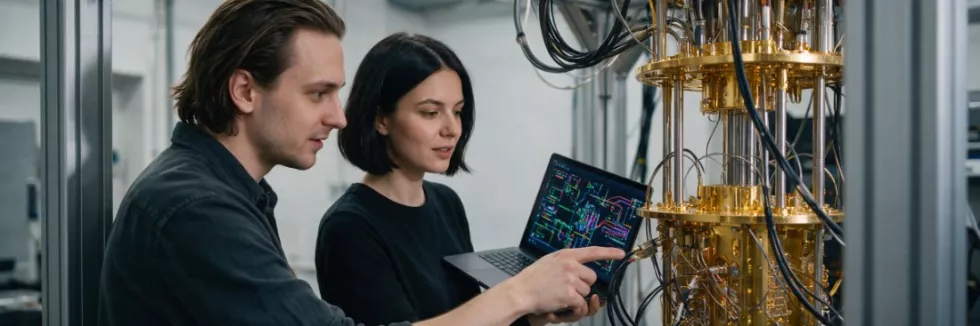
researchers-beside-a-golden-quantum-computer-cryostat

10 questions · two minutes

1. How do you feel about linear algebra in complex vector spaces – the language of qubits?

2. You’re asked to build a quantum circuit for a simple algorithm and run it on a simulator. How do you react?

3. Your results on real quantum hardware differ from the simulation because of noise. What do you do?

4. How do you feel about quantum cryptography and the threat quantum computers pose to current encryption?

5. The programme is taught in English, and you’ll work on projects with students from many countries. How do you feel about that?

6. Which thesis topic appeals to you most?

7. The field moves so fast that new results appear every few months. How do you feel about that?

8. Someone claims quantum computers will soon solve every problem instantly. How do you respond?

9. How comfortable are you with programming in Python and using quantum software libraries?

10. What motivates you most to pursue a Master’s degree in Quantum Information Technology?

⇑Definitions and quotes

Information
Information is any entity or form that provides the answer to a question of some kind or resolves uncertainty. It is thus related to data and knowledge, as data represents values attributed to parameters, and knowledge signifies understanding of real things or abstract concepts. As it regards data, the information's existence is not necessarily coupled to an observer (it exists beyond an event horizon, for example), while in the case of knowledge, the information requires a cognitive observer.
Information Technology
Information technology (IT) is the use of computers to store, retrieve, transmit, and manipulate data, or information, often in the context of a business or other enterprise. IT is considered to be a subset of information and communications technology (ICT).
Quantum
In physics, a quantum (plural: quanta) is the minimum amount of any physical entity (physical property) involved in an interaction. The fundamental notion that a physical property may be "quantized" is referred to as "the hypothesis of quantization". This means that the magnitude of the physical property can take on only discrete values consisting of integer multiples of one quantum.
Technology
Technology ("science of craft", from Greek τέχνη, techne, "art, skill, cunning of hand"; and -λογία, -logia) is first robustly defined by Jacob Bigelow in 1829 as: "...principles, processes, and nomenclatures of the more conspicuous arts, particularly those which involve applications of science, and which may be considered useful, by promoting the benefit of society, together with the emolument [compensation ] of those who pursue them" .
Technology
When technology makes it perfect, art loses.
Brian Eno, as quoted in Wired (January 1999)
Information
Knowledge is of two kinds. We know a subject ourselves, or we know where we can find information upon it.
Samuel Johnson, Boswell's Life of Johnson, 18th April 1775.
Information Technology
Our exploration of emergent social structures across domains of human activity and experience leads to an over-arching conclusion: as an historical trend, dominant functions and processes in the Information Age are increasingly organized around networks. Networks constitute the new social morphology of our societies, and the diffusion of networking logic substantially modifies the operation and outcomes in processes of production, experience, power, and culture. While the networking form of social organization has existed in other times and spaces, the new information technology paradigm provides the material basis for its pervasive expansion throughout the entire social structure.
Manuel Castells (1996) The Rise of the Network Society: The Information Age: Economy, Society, and Culture Volume I (Information Age Series). p. 500.

Contact:

Maii Janion 7 street
80-309 Gdańsk
tel. +48 58 523 25 32
Privacy Policy