
Warsaw, Poland

Landscape Architecture under Climate Change

Master's
Table of contents
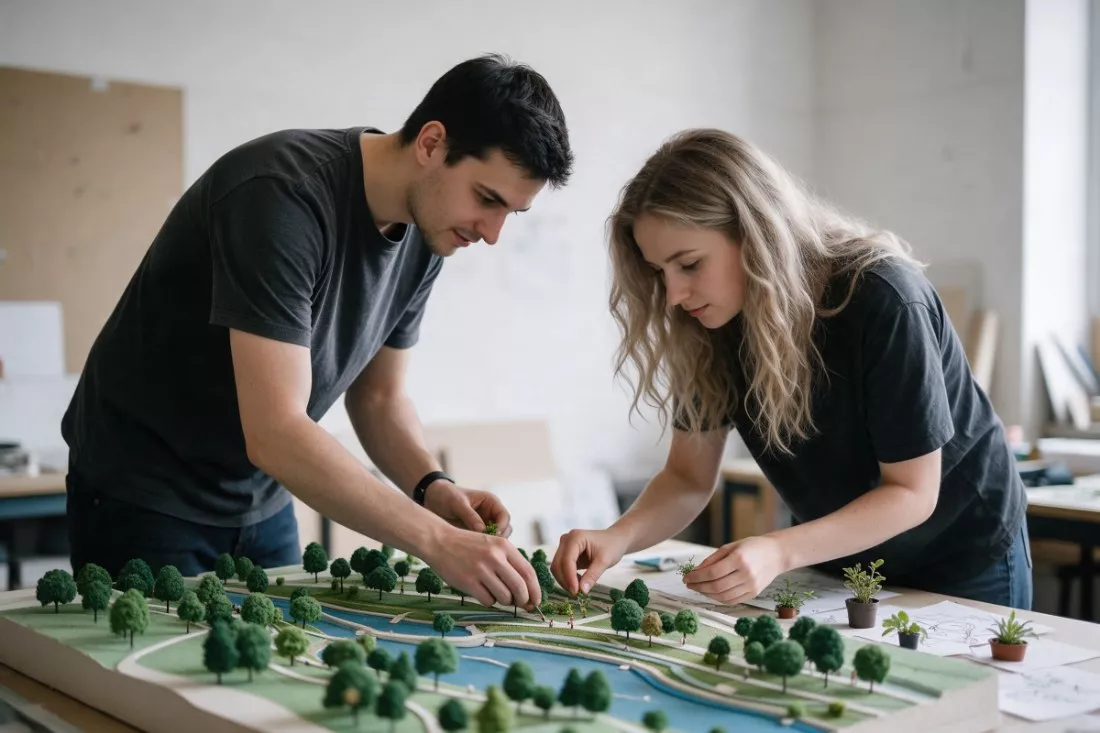
architekci-krajobrazu-pracuja-nad-makieta-parku

⇑Landscape Architecture under Climate Change at SGGW

Language: EnglishStudies in English
Subject area: agriculture, forestry and fishery, veterinary
Kind of studies: full-time studies
  • Description:

  • pl
University website: www.sggw.edu.pl/en

⇑Why study Landscape Architecture under Climate Change (Master's) at the Warsaw University of Life Sciences – SGGW?

Dlaczego warto studiować w Szkole Głównej Gospodarstwa Wiejskiego w Warszawie
Why study it:

Landscape Architecture under Climate Change is a Master's programme at the Warsaw University of Life Sciences – SGGW, taught in English. It lasts four semesters (two years) and ends with a vocational Master's degree, so it suits you if you want to design landscapes that can cope with a changing climate.

Programme: design for resilience and biodiversity

You start with green infrastructure, both theory and application, design strategies for climate change adaptation and resilience, and the methods and tools of landscape architecture. Studio work is a big part of the programme: you take a Biodiversity Oriented Studio, a studio on a local initiative for climate change adaptation and one on a landscape-sensitive masterplan. Along the way you learn about sustainable planting plans, the selection and use of sustainable materials and technologies, nature-based solutions and landscape planning.

Later you can look at resilience strategies for planning and management in subarctic, temperate or tropical landscapes. You also choose electives such as biodiversity in ornamental and cultural contexts, the value of trees, temporary gardens or modern monitoring technology for the natural environment, as well as humanities and social science courses such as environmental psychology and sociology, social research and the history of landscape architecture. The studies close with diploma seminars and a diploma studio.

Languages: foreign language course

The programme also includes a foreign-language course chosen from an open list: English, German, Russian or Spanish.

Based on the programme pages at sggw.edu.pl and the SGGW syllabus.
⇑Test: Is Landscape Architecture under Climate Change the right fit for you?

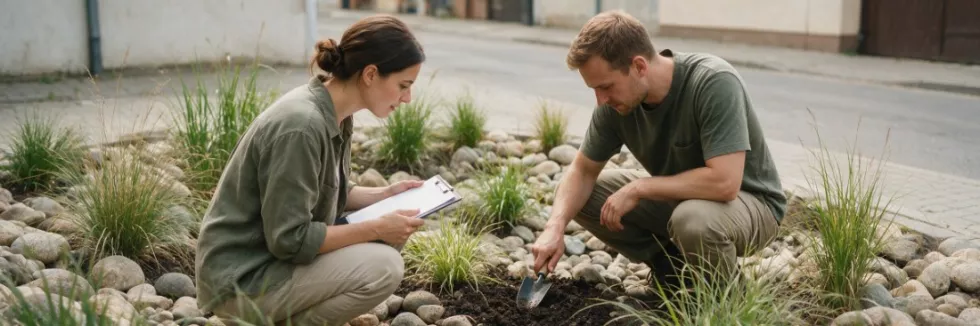
landscape-architects-inspecting-an-urban-rain-garden

10 questions · two minutes

1. On a placement you’re designing a square in a city centre that overheats every summer. Where do you start?

2. After a cloudburst, part of a park you helped design turns into a huge puddle. How do you respond?

3. How do you choose plants for a scheme?

4. At Master’s level you’ll discuss designs, read climate research and present concepts in English, in a studio with people from many countries. How does that sound?

5. How do you use digital tools in design?

6. Residents complain because a wildflower meadow is planned instead of a lawn, and they say it ‘looks neglected’. What do you do?

7. How do you think about time in landscape design?

8. Who do you want to work with on a project?

9. You’re choosing a topic for your Master’s dissertation. What draws you?

10. What motivates you most to pursue a Master’s degree in Landscape Architecture under Climate Change?

⇑Definitions and quotes

Architecture
Architecture is both the process and the product of planning, designing, and constructing buildings or any other structures. Architectural works, in the material form of buildings, are often perceived as cultural symbols and as works of art. Historical civilizations are often identified with their surviving architectural achievements.
Climate
Climate is the statistics of weather over long periods of time. It is measured by assessing the patterns of variation in temperature, humidity, atmospheric pressure, wind, precipitation, atmospheric particle count and other meteorological variables in a given region over long periods of time. Climate differs from weather, in that weather only describes the short-term conditions of these variables in a given region.
Climate Change
Climate change is a change in the statistical distribution of weather patterns when that change lasts for an extended period of time (i.e., decades to millions of years). Climate change may refer to a change in average weather conditions, or in the time variation of weather within the context of longer-term average conditions. Climate change is caused by factors such as biotic processes, variations in solar radiation received by Earth, plate tectonics, and volcanic eruptions. Certain human activities have been identified as primary causes of ongoing climate change, often referred to as global warming.
Landscape
A landscape is the visible features of an area of land, its landforms and how they integrate with natural or man-made features.
Landscape Architecture
Landscape architecture is the design of outdoor areas, landmarks, and structures to achieve environmental, social-behavioural, or aesthetic outcomes. It involves the systematic investigation of existing social, ecological, and soil conditions and processes in the landscape, and the design of interventions that will produce the desired outcome. The scope of the profession includes landscape design; site planning; stormwater management; environmental restoration; parks and recreation planning; visual resource management; green infrastructure planning and provision; and private estate and residence landscape master planning and design; all at varying scales of design, planning and management. A practitioner in the profession of landscape architecture is called a landscape architect.
Architecture
Architects and engineers are among the most fortunate of men since they build their own monuments with public consent, public approval and often public money.
John Prebble, in Disaster at Dundee, 1956. p. 16.
Architecture
The modern age has in most cases failed with the rebuilding of old cities destroyed in the war and shown itself incapable of recreating the complex grain of places which took centuries to evolve. Clearly our modern architectural vocabulary just isn't up to the job.
Dieter Scholzel (architect); reported in Friends of Dresden declarations (2003).
Architecture
‘Architecture’ may at first appear to be a more fixed and finite term. It has a threedimensional, tangible, useable form. But questions remain about what can be considered architecture and what cannot, and by this I mean that we usually understand architecture to incorporate aesthetic as well as functional consideration into its structure. Anything that does not fall into this category can be described as ‘just a building’. This may seem too simple. Can architecture be determined solely by the use of refined architectural style – high or polite architecture instead of vernacular?
Dana Arnold, Reading Architectural History (2002), Ch. 1 : Reading the past : What is architectural history?

Contact:

Nowoursynowska 166 str.
02-787 Warszawa
tel. (48 22) 59 31 000
StudentNews Group Websites for students and future students — in Poland since 2007, across Europe since 2014. Over 50 websites and millions of users a year (Google Analytics). Studies in Europe Universities in Europe Bachelor’s Master’s Doctorate MBA Study guide Work abroad Travel For partners Advertising and cooperation Reach (online report) Contact advertising@studentnews.eu © 2003–2026 Grupa StudentNews.pl sp. z o.o., Modlnica, Poland
Privacy Policy