
Cracow, Poland

Industrial Brewing and Beverage Technology

Master's
Table of contents
studenci-technologii-piwowarstwa-ogladaja-slod

⇑Industrial Brewing and Beverage Technology at URK

Language: EnglishStudies in English
Subject area: engineering and engineering trades
Kind of studies: full-time studies

⇑Why study Industrial Brewing and Beverage Technology (Master's) at URK?

dlaczego-warto-studiowac-na-URK
Why study it:

At the University of Agriculture in Krakow (URK), Industrial Brewing and Beverage Technology is a full-time Master's programme in English run by the Faculty of Food Technology in the discipline of nutrition and food technology. It is designed for graduates of food technology, brewing, biotechnology and related engineering fields who want to specialise in the production of beverages, with brewing at the centre.

Programme: beer and other fermented beverages

The studies focus on the technology of alcoholic and non-alcoholic beverages, mainly fermented ones. You learn:

  • how the properties of raw materials and the course of technological processes affect the quality and stability of finished beverages
  • to design, analyse and optimise production processes in the beverage industry
  • to assess raw materials, semi-finished products and finished beverages with modern analytical methods and statistical tools
  • to plan and conduct technological research, interpret results and implement innovative solutions
  • how beverage companies work, including quality management, food safety systems and basic legal requirements of the food industry

Languages: a programme in English

The programme is taught in English – it is part of the URK Study in English offer of Master's studies.

After graduation: technology, R and D and quality control

Graduates are prepared to work in technological, research and development and quality control teams in beverage industry enterprises. They can solve technological problems independently and take part in improving production processes. The programme also gives the competencies needed to continue education in doctoral programmes in disciplines related to food technology and nutrition.

As of the 2026/27 admissions, based on the programme page at urk.edu.pl.
⇑Test: Is Industrial Brewing and Beverage Technology the right fit for you?

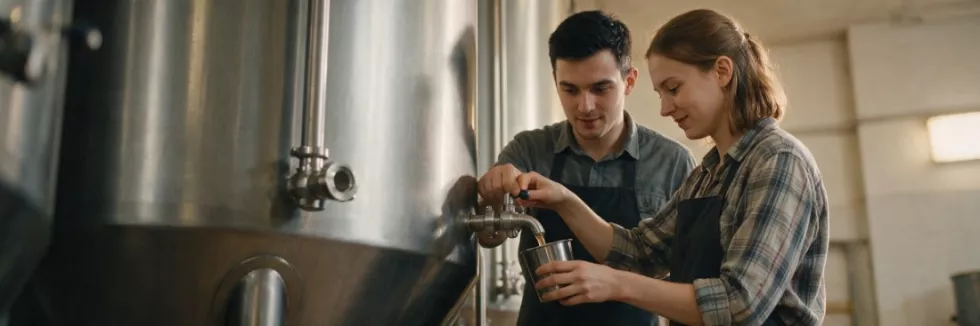
brewing-students-taking-a-sample-from-a-fermentation-tank

10 questions · two minutes

1. During a placement at a brewery, you notice that a new batch tastes different from the previous ones. What do you do?

2. How do you feel about microbiology – yeast, bacteria, contamination control?

3. A company wants to launch a new drink – say, an alcohol-free one or a fruit-based fermented one. What do you take into account?

4. You’ll read research papers, write reports and present projects in English, in a group with people from many countries. How does that sound?

5. You’re on a sensory panel evaluating several drink samples. How do you approach it?

6. In a modern brewery, most stages of production are automated. How do you feel about that?

7. A brewery uses a lot of water and energy, and production leaves spent grain behind. How do you approach this?

8. An audit reveals that contamination could build up at one point on the bottling line. What do you suggest?

9. Where do you see yourself after graduating?

10. What motivates you most to pursue a Master’s degree in Industrial Brewing and Beverage Technology?

⇑Definitions and quotes

Brewing
Brewing is the production of beer by steeping a starch source (commonly cereal grains, the most popular of which is barley) in water and fermenting the resulting sweet liquid with yeast. It may be done in a brewery by a commercial brewer, at home by a homebrewer, or by a variety of traditional methods such as communally by the indigenous peoples in Brazil when making cauim. Brewing has taken place since around the 6th millennium BC, and archaeological evidence suggests that emerging civilizations including ancient Egypt and Mesopotamia brewed beer. Since the nineteenth century the brewing industry has been part of most western economies.
Technology
Technology ("science of craft", from Greek τέχνη, techne, "art, skill, cunning of hand"; and -λογία, -logia) is first robustly defined by Jacob Bigelow in 1829 as: "...principles, processes, and nomenclatures of the more conspicuous arts, particularly those which involve applications of science, and which may be considered useful, by promoting the benefit of society, together with the emolument [compensation ] of those who pursue them" .
Technology
It is the constant attempt in this country [Canada] to make fundamental science responsive to the marketplace. Because technology needs science, it is tempting to require that scientific projects be justified in terms of the worth of the technology they can be expected to generate. The effect of applying this criterion is, however, to restrict science to developed fields where the links to technology are most evident. By continually looking for a short-term payoff we disqualify the sort of science that … attempts to answer fundamental questions, and, having answered them, suggests fundamentally new approaches in the realm of applications.
John C. Polanyi, A Scientist and the World He Lives In, Speech to the Empire Club of Canada (27 Nov 1986) in C. Frank Turner and Tim Dickson (eds.), The Empire Club of Canada Speeches 1986-1987 (1987), 149-161.
Technology
The marriage of reason and nightmare which has dominated the 20th century has given birth to an ever more ambiguous world. Across the communications landscape move the specters of sinister technologies and the dreams that money can buy. Thermonuclear weapons systems and soft drink commercials coexist in an overlit realm ruled by advertising and pseudoevents, science and pornography. Over our lives preside the great twin leitmotifs of the 20th century—sex and paranoia.
J. G. Ballard, Crash (1973, 1995), catalogue notes. In J. G. Ballard, The Kindness of Women (2007), 221.
Technology
The path towards sustainable energy sources will be long and sometimes difficult. But America cannot resist this transition, we must lead it. We cannot cede to other nations the technology that will power new jobs and new industries, we must claim its promise. That’s how we will maintain our economic vitality and our national treasure—our forests and waterways, our crop lands and snow-capped peaks. That is how we will preserve our planet, commanded to our care by God. That’s what will lend meaning to the creed our fathers once declared.
Barack Obama In Second Inaugural Address (21 Jan 2013) at the United States Capitol.

Contact:

Al. Mickiewicza 21
31-120 Kraków
tel. 12 662 43 34
StudentNews Group Websites for students and future students — in Poland since 2007, across Europe since 2014. Over 50 websites and millions of users a year (Google Analytics). Studies in Europe Universities in Europe Bachelor’s Master’s Doctorate MBA Study guide Work abroad Travel For partners Advertising and cooperation Reach (online report) Contact advertising@studentnews.eu © 2003–2026 Grupa StudentNews.pl sp. z o.o., Modlnica, Poland
Privacy Policy