
Częstochowa, Poland

Chemistry in Forensics
(field of studies: Chemistry)

Bachelor's
Table of contents
science-chemistry-formula-illustration-science-glass

⇑Chemistry in Forensics at UJD

Field of studies: Chemistry
Language: EnglishStudies in English
Subject area: physical science, environment
Kind of studies: full-time studies, part-time studies
  • Description:

  • pl
University website: www.en.ujd.edu.pl

⇑Why choose the Chemistry in Forensics specialisation at UJD?

Dlaczego warto studiować na UJD
Why study it:

Chemistry in Forensics is a specialisation in the Chemistry programme (first-degree studies, taught in English) at Jan Długosz University in Częstochowa. It suits people who want to use chemistry and biology to examine traces, substances and evidence.

Specialisation: what the forensic track covers

On top of the core chemistry courses, you study subjects such as:

  • organic chemistry in forensics – organic traces, narcotics, fibres and polymers, dyes and pigments, explosives and flammable materials,
  • toxicology – how poisons behave in the body, heavy metals, pesticides and food toxicology,
  • biochemistry and molecular biology in forensics, including DNA analysis used in forensic work and forensic medicine,
  • botany in forensics – plants and pollen as clues to a crime scene,
  • chemical metrology – measurement uncertainty, reference materials and validation of analytical procedures,
  • an optional module on forensic chemistry and security threats – monitoring security threats, analysis methods in forensic chemistry, biological and microbiological threats.

Labs: instruments and imaging techniques

You learn to work with modern analytical equipment and to apply chromatographic and spectroscopic techniques in practice. Just as important is the next step: interpreting the results and drawing sound conclusions from them.

A separate course introduces imaging techniques used in forensic work, from computed tomography and magnetic resonance to optical and scanning electron microscopy, UV-VIS, Raman and infrared spectroscopy, and X-ray diffraction. Two elective specialist courses let you tailor the track to your own interests.

After graduation: where it leads

The skills you gain – analysing samples, working with instruments and interpreting results – are useful in chemical, cosmetic and pharmacological laboratories, both industrial and research ones. After the first-degree studies you can continue with second-degree studies in Chemistry.

Based on the study plan and the UJD admissions page.

Updated: 11.11.2026
⇑Test: Is Chemistry in Forensics the right fit for you?

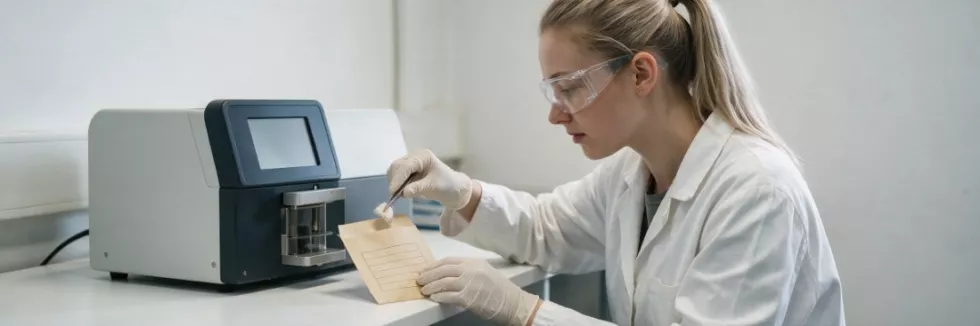
forensic-chemistry-student-handling-a-fibre-sample-in-a-lab

10 questions · two minutes

1. A white powder is found at a crime scene. What would you most like to do?

2. How do you feel about extremely careful, repetitive lab work where one mistake could ruin the evidence?

3. Which topic would you most like to explore?

4. You have to document every sample: who handled it, when and where it was stored. How do you react?

5. How do you feel about working with toxic substances, blood samples or unpleasant materials?

6. Two lab tests on the same sample give different results. What do you do?

7. The programme is taught in English, and you’ll share the lab with students from many countries. How do you feel about that?

8. Imagine explaining your lab results to a court as an expert witness. How does that sound?

9. How do you get on with chemistry and biology at school?

10. What motivates you most to study Chemistry in Forensics?

⇑Definitions and quotes

Chemistry
Chemistry is the scientific discipline involved with compounds composed of atoms, i.e. elements, and molecules, i.e. combinations of atoms: their composition, structure, properties, behavior and the changes they undergo during a reaction with other compounds. Chemistry addresses topics such as how atoms and molecules interact via chemical bonds to form new chemical compounds. There are four types of chemical bonds: covalent bonds, in which compounds share one or more electron(s); ionic bonds, in which a compound donates one or more electrons to another compound to produce ions (cations and anions); hydrogen bonds; and Van der Waals force bonds.
Chemistry
Just think of the differences today. A young person gets interested in chemistry and is given a chemical set. But it doesn't contain potassium cyanide. It doesn't even contain copper sulfate or anything else interesting because all the interesting chemicals are considered dangerous substances. Therefore, these budding young chemists don't get a chance to do anything engrossing with their chemistry sets. As I look back, I think it is pretty remarkable that Mr. Ziegler, this friend of the family, would have so easily turned over one-third of an ounce of potassium cyanide to me, an eleven-year-old boy.
Linus Pauling In His Own Words (1995) by Barbara Marinacci, p. 29
Chemistry
I praise the chemical physicians, for they do not go about gorgeous in satins, silks, and velvets, silver daggers hanging at their sides, and white gloves on their hands, but they tend their work at the fire patiently day and night. They do not go promenading, but seek their recreation in laboratory. They thrust their fingers among the coals into dirt and rubbish and not into golden rings.
Paracelsus (in Jaffe, Bernard. Crucibles: The Story of Chemistry. 4th Edition. New York: Dover, 1976. (Originally, 1930) | Pgs. 13-24)
Chemistry
We may, I believe, anticipate that the chemist of the future who is interested in the structure of proteins, nucleic acids, polysaccharides, and other complex substances with high molecular weight will come to rely upon a new structural chemistry, involving precise geometrical relationships among the atoms in the molecules and the rigorous application of the new structural principles, and that great progress will be made, through this technique, in the attack, by chemical methods, on the problems of biology and medicine.
Linus Pauling, Nobel Lecture (11 December 1954)

Contact:

Waszyngtona str. 4/8
42-200 Częstochowa
phone +48 34 378 41 00
StudentNews Group Websites for students and future students — in Poland since 2007, across Europe since 2014. Over 50 websites and millions of users a year (Google Analytics). Studies in Europe Universities in Europe Bachelor’s Master’s Doctorate MBA Study guide Work abroad Travel For partners Advertising and cooperation Reach (online report) Contact advertising@studentnews.eu © 2003–2026 Grupa StudentNews.pl sp. z o.o., Modlnica, Poland
Privacy Policy