
Warsaw, Poland

Generative AI Engineering
(field of studies: Computer Science)

Bachelor's - engineer
Table of contents
studenci-testuja-generatywna-ai-w-pracowni-komputerowej

⇑Generative AI Engineering at PJATK

Field of studies: Computer Science
Language: EnglishStudies in English
Subject area: computer science
Kind of studies: full-time studies
Studies online Studies online
University website: www.pja.edu.pl/en/

⇑Why choose the Generative AI Engineering specialisation at the Polish-Japanese Academy of Information Technology?

Dlaczego warto studiować w Polsko-Japońskiej Akademii Technik Komputerowych
Why study it:

Generative AI Engineering is a specialisation within the Computer Science programme, a full-time Bachelor's course taught in English at the Polish-Japanese Academy of Information Technology (PJAIT). It is aimed at those who want to build, tune and deploy modern generative and multimodal AI systems.

Programme: from deep learning to deployment

The specialisation follows the whole lifecycle of an AI system, and you work with:

  • deep learning architectures such as CNNs, RNNs, autoencoders, GANs and Transformers
  • generative and multimodal models, including Vision Transformers, diffusion models and CLIP
  • Retrieval-Augmented Generation (RAG) systems and agent-based systems
  • efficient fine-tuning with LoRA and adapters, and model compression through quantisation, distillation and pruning
  • model alignment (RLHF, DPO) and reinforcement learning, including applications in robotics
  • AI and MLOps engineering: APIs, Docker, CI/CD, MLflow and Kubernetes

Specialisation: courses and projects

The specialisation courses are Deep Learning in Python, which covers fundamental and advanced techniques, model implementation and projects, and Generative AI, which deals with modern generative and multimodal models, optimisation, alignment and agent-based systems. Project-based classes follow: the first concentrates on AI and MLOps systems engineering and model-as-a-service deployment, the second on trends such as scaling laws, security and model economics, and the third prepares you for writing and presenting your thesis. In the sixth semester you are encouraged to take the elective Methods of Knowledge Engineering.

Labs: project-based, engineering-focused labs

The labs are project-based and engineering-focused. You implement models from scratch in NumPy, PyTorch and TensorFlow, build RAG, multimodal search and diffusion systems, and then turn them into working services with FastAPI, Docker, data pipelines, monitoring and deployments on Kubernetes.

After graduation: AI and ML engineering roles

Graduates are prepared to work as AI engineers, ML engineers or generative systems specialists, in fields such as IT, robotics, the creative sector, medicine and data analysis.

Because the programme stresses practical implementation, you can join both product teams and research and development teams. Thesis topics show the direction: a RAG system for knowledge retrieval, a multimodal image-text search based on CLIP, or the optimisation of language models with LoRA and quantisation.

Based on the programme pages at pja.edu.pl.

⇑Test: Is Generative AI Engineering the right fit for you?

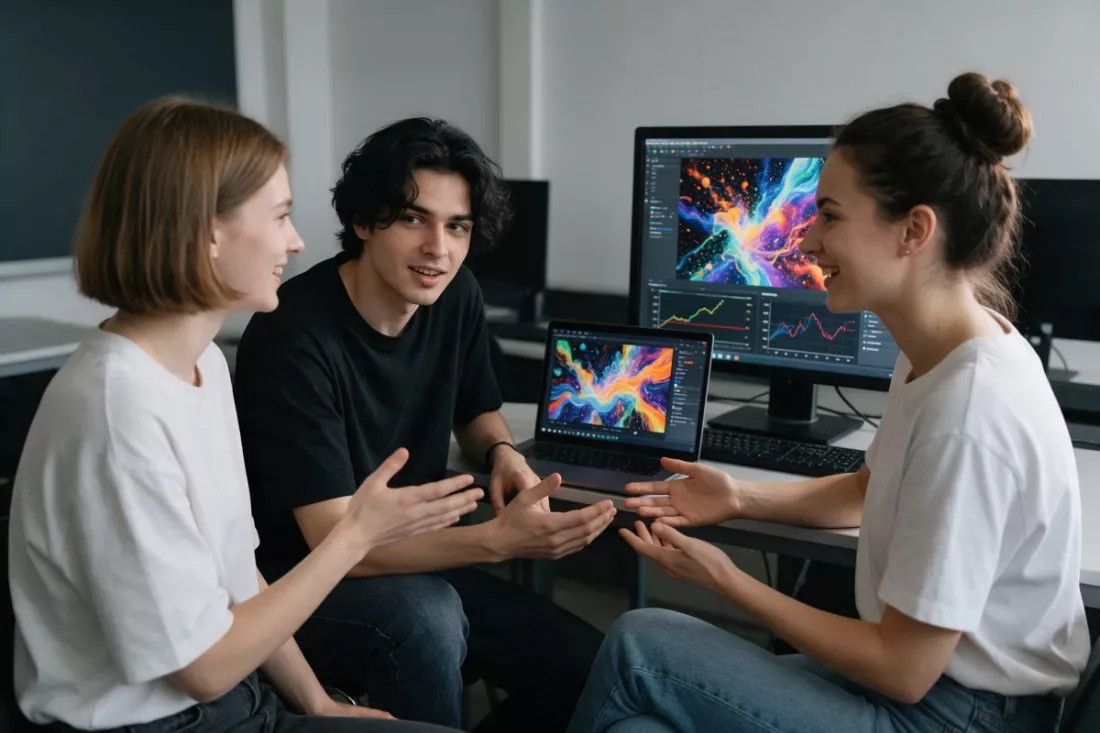
students-working-on-a-generative-ai-model-at-laptops

10 questions · two minutes

1. You use an AI chatbot to help you study. What fascinates you most about it?

2. How do you get on with maths, such as functions, probability and statistics?

3. Do you code, or have you ever tried?

4. Lectures, documentation, AI research papers and team projects will all be in English, in a group with people from many countries. How does that sound?

5. An AI chatbot confidently tells you something that turns out to be false. What do you make of it?

6. You come up with the idea of using AI to build, say, a bot that answers questions about your school. What do you do?

7. There’s a lot of debate about deepfakes and copyright in AI-generated content. What’s your view?

8. You generate an image or a piece of music with AI. What do you do with the result?

9. Where do you see yourself in the future?

10. What motivates you most to study Generative AI Engineering?

⇑Definitions and quotes

Engineering
Engineering is the creative application of science, mathematical methods, and empirical evidence to the innovation, design, construction, operation and maintenance of structures, machines, materials, devices, systems, processes, and organizations. The discipline of engineering encompasses a broad range of more specialized fields of engineering, each with a more specific emphasis on particular areas of applied mathematics, applied science, and types of application. See glossary of engineering.
Engineering
When I looked at the science of engineering and saw that it had disappeared after its ancient heritage, that its masters have perished, and that their memories are now forgotten, I worked my wits and thoughts in secrecy about philosophical shapes and figures, which could move the mind, with effort, from nothingness to being and from idleness to motion. And I arranged these shapes one by one in drawings and explained them
Al-Muradi, The Book of Secrets in the Results of Ideas, 11th century; Translated and cited at leonardo3.net/bookofsecrets/index, 2015
Engineering
Engineering is the art of directing the great sources of power in nature for the use and convenience of man.
Thomas Tredgold (1828), used in the Royal Charter of the Institution of Civil Engineers (ICE) published in: The Times, London, article CS102127326, 30 June 1828.
Engineering
A good scientist is a person with original ideas. A good engineer is a person who makes a design that works with as few original ideas as possible. There are no prima donnas in engineering.
Freeman Dyson in Freeman J. Dyson. Disturbing the universe. Harper & Row. ISBN 978-0-06-090771-6. 

Contact:

Koszykowa str. 86
02-008 Warsaw
phone: (+48) 22 58 44 500
fax: (+48) 22 58 44 501
StudentNews Group Websites for students and future students — in Poland since 2007, across Europe since 2014. Over 50 websites and millions of users a year (Google Analytics). Studies in Europe Universities in Europe Bachelor’s Master’s Doctorate MBA Study guide Work abroad Travel For partners Advertising and cooperation Reach (online report) Contact advertising@studentnews.eu © 2003–2026 Grupa StudentNews.pl sp. z o.o., Modlnica, Poland
Privacy Policy