Warsaw, Poland

EXtended Reality, Immersive Games and Systems
(field of studies: Computer Science)

Bachelor's - engineer
Table of contents
studenci-projektuja-gre-3d-przy-monitorach

⇑EXtended Reality, Immersive Games and Systems at PJATK

Field of studies: Computer Science
Language: EnglishStudies in English
Subject area: computer science
Kind of studies: full-time studies
  • Description:

  • pl
University website: www.pja.edu.pl/en/

⇑Test: Is EXtended Reality, Immersive Games and Systems the right fit for you?

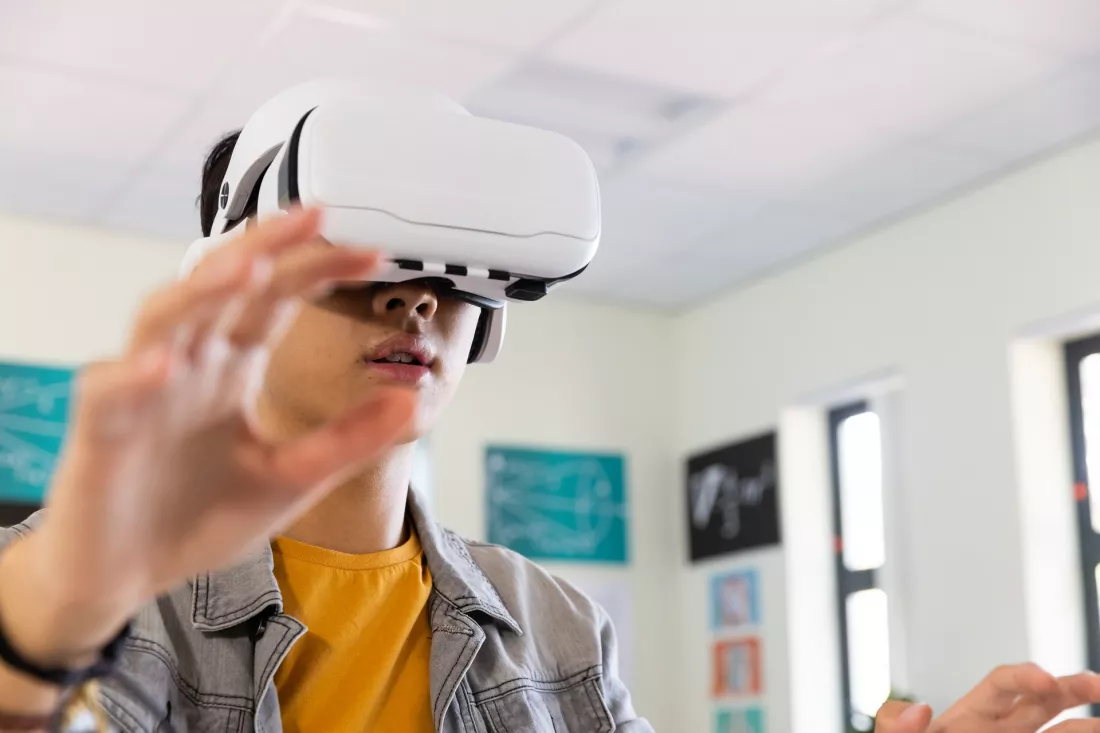
student-testing-a-vr-headset-while-a-friend-watches-a-laptop

10 questions · two minutes

1. You try on a VR headset for the first time, say at a tech fair or a friend’s place. How do you feel?

2. What part do games play in your life?

3. How do you get on with maths, especially geometry and vectors?

4. Your simple game runs, but the character walks straight through walls. What do you do?

5. Classes, engine documentation and tools will all be in English, and you’ll build projects in an international team. How does that sound?

6. Which part of creating a VR or AR app interests you most?

7. Someone says virtual reality is just a gaming gadget. What do you say?

8. How do you work in a group on a shared project, like a school film or a game jam?

9. What do you picture yourself doing in the future?

10. What motivates you most to study EXtended Reality, Immersive Games and Systems?

⇑Definitions and quotes

Reality
Reality is the sum or aggregate of all that is real or existent, as opposed to that which is merely imaginary. The term is also used to refer to the ontological status of things, indicating their existence. Philosophical questions about the nature of reality or existence or being are considered under the rubric of ontology, which is a major branch of metaphysics in the Western philosophical tradition. Ontological questions also feature in diverse branches of philosophy, including the philosophy of science, philosophy of religion, philosophy of mathematics, and philosophical logic. These include questions about whether only physical objects are real (i.e., Physicalism), whether reality is fundamentally immaterial (e.g., Idealism), whether hypothetical unobservable entities posited by scientific theories exist, whether God exists, whether numbers and other abstract objects exist, and whether possible worlds exist.
Reality
We have always had a great deal of difficulty understanding the world view that quantum mechanics represents. At least I do, because I'm an old enough man that I haven't got to the point that this stuff is obvious to me. Okay, I still get nervous with it.... You know how it always is, every new idea, it takes a generation or two until it becomes obvious that there's no real problem. I cannot define the real problem, therefore I suspect there's no real problem, but I'm not sure there's no real problem.
Richard Feynman, in Simulating Physics with Computers appearing in International Journal of Theoretical Physics (1982) p. 471.
Reality
Already in 1948, observations... agreed with quantum mechanics, not with local realism.
R. H. Dalitz and F. J. Duarte, John Clive Ward, Physics Today 53, 99-100 (2000).
Reality
Reality has a well-known liberal bias.
Stephen Colbert, at the White House Correspondents' Association Dinner (2006)

Contact:

Koszykowa str. 86
02-008 Warsaw
phone: (+48) 22 58 44 500
fax: (+48) 22 58 44 501
Privacy Policy