
Białystok, Poland

Applied Chemistry

Master's
Table of contents
Applied Chemistry study

⇑Applied Chemistry at UwB

Language: EnglishStudies in English
Subject area: physical science, environment
Kind of studies: full-time studies
  • Description:

  • pl
University website: uwb.edu.pl/en/

⇑Why study Applied Chemistry (Master's) at the University of Bialystok?

Studiuj na UwB – Uniwersytet w Białymstoku
Why study it:

Applied Chemistry at the University of Bialystok is a two-year master's programme run by the Faculty of Chemistry and taught in English. It is for graduates who want to deepen their chemistry, work with modern instruments and choose between two specialisations: chemistry of materials or chemical analysis.

Programme: advanced chemistry across several fields

The core of the programme covers coordination and metalloorganic chemistry, advanced analytical chemistry and advanced organic chemistry, with laboratories on modern synthesis and on identifying compounds. You also study the physical side of advanced techniques, molecular spectroscopy (infrared, Raman, ultraviolet and NMR), and chromatography and electrophoresis, including coupled techniques. Two further subjects look at sustainable chemistry for the circular economy and at good laboratory practice, from standard procedures and quality control to accreditation and laboratory management systems.

Specialisation: two specialisations to choose from

Specialisations at a glance

  • Chemistry of materialsenergy storage materials, nanomaterials, polymers and conducting polymers, catalytic processes, structural chemistry and advanced methods of analysing materials
  • Chemical analysissampling and sample preparation, atomic spectrometry, process, toxicological and surface analysis, bioanalysis, ecoanalysis and environmental chemistry

Labs: hands-on laboratory work

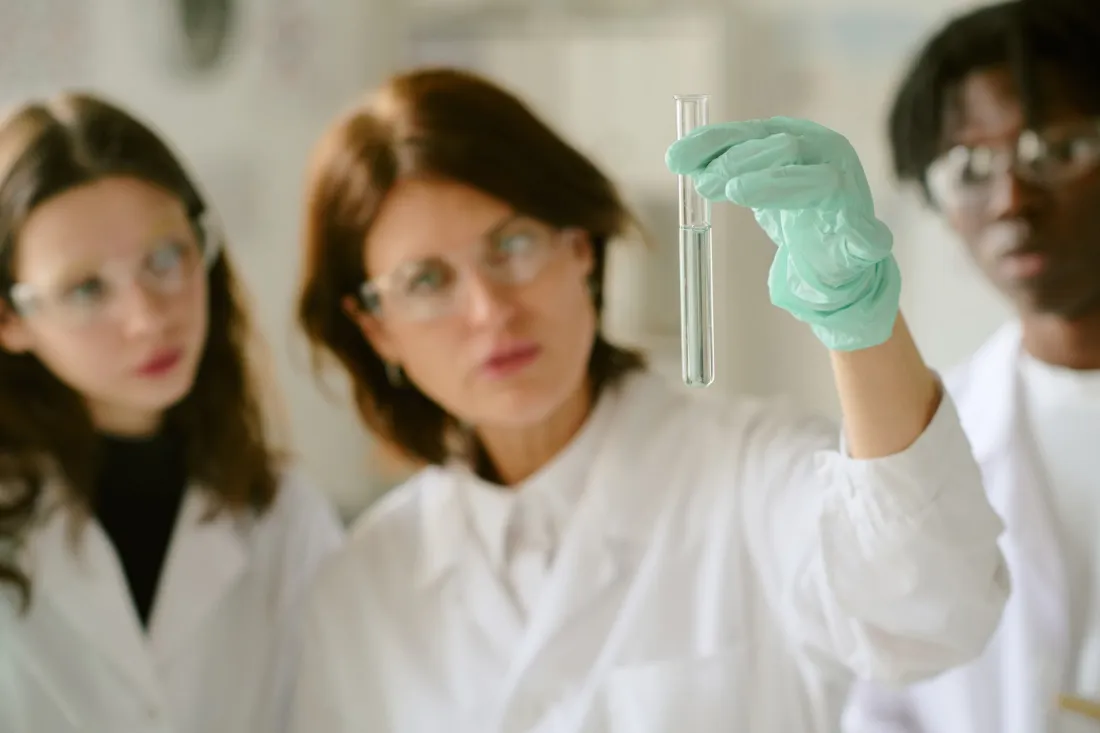
Much of the learning happens in the laboratory, where you for example:

  • work with spectroscopic methods to identify organic and inorganic compounds;
  • carry out controlled polymerisation and characterise the polymers you obtain;
  • perform inorganic analyses with atomic absorption spectrometry and ICP-MS;
  • determine pollutants such as pesticide and drug residues in water, soil and plants using GC-MS and LC-MS/MS;
  • test modern water purification technologies by measuring water pollution indicators.

After graduation: a master's thesis and professional skills

In the diploma module you complete a master's thesis in the specialisation laboratory and the master's seminar: you collect literature, plan and perform experiments, and discuss your results against published data. Along the way you learn to work in a team, present specialised issues in English and follow the principles of entrepreneurship and of protecting intellectual property.

Based on the programme pages and curriculum documents of UwB.
⇑Test: Is Applied Chemistry the right fit for you?

Applied Chemistry test

Answer all questions and check if Applied Chemistry is the right Master’s degree for you!

1. Do you want to deepen your knowledge in advanced chemical processes and their practical applications?

2. Are you interested in laboratory research, experiments, and analytical techniques?

3. Do you want to pursue a career in industries such as pharmaceuticals, energy, or materials engineering?

4. Are you ready to work on interdisciplinary projects connecting chemistry with biology, physics, and engineering?

5. Will completing a two-year Master’s programme in Applied Chemistry increase your competitiveness in the job market?

6. Do you want to develop expertise in chemical technologies, sustainable energy, or nanomaterials?

7. Are you motivated to improve your problem-solving and critical thinking skills through advanced chemistry courses?

8. Do you want to contribute to innovative solutions for environmental and technological challenges?

9. Are you ready to work in teams with other scientists and engineers on research and development projects?

10. What is your main motivation for pursuing a Master’s in Applied Chemistry?

⇑Definitions and quotes

Chemistry
Chemistry is the scientific discipline involved with compounds composed of atoms, i.e. elements, and molecules, i.e. combinations of atoms: their composition, structure, properties, behavior and the changes they undergo during a reaction with other compounds. Chemistry addresses topics such as how atoms and molecules interact via chemical bonds to form new chemical compounds. There are four types of chemical bonds: covalent bonds, in which compounds share one or more electron(s); ionic bonds, in which a compound donates one or more electrons to another compound to produce ions (cations and anions); hydrogen bonds; and Van der Waals force bonds.
Chemistry
Just think of the differences today. A young person gets interested in chemistry and is given a chemical set. But it doesn't contain potassium cyanide. It doesn't even contain copper sulfate or anything else interesting because all the interesting chemicals are considered dangerous substances. Therefore, these budding young chemists don't get a chance to do anything engrossing with their chemistry sets. As I look back, I think it is pretty remarkable that Mr. Ziegler, this friend of the family, would have so easily turned over one-third of an ounce of potassium cyanide to me, an eleven-year-old boy.
Linus Pauling In His Own Words (1995) by Barbara Marinacci, p. 29
Chemistry
I praise the chemical physicians, for they do not go about gorgeous in satins, silks, and velvets, silver daggers hanging at their sides, and white gloves on their hands, but they tend their work at the fire patiently day and night. They do not go promenading, but seek their recreation in laboratory. They thrust their fingers among the coals into dirt and rubbish and not into golden rings.
Paracelsus (in Jaffe, Bernard. Crucibles: The Story of Chemistry. 4th Edition. New York: Dover, 1976. (Originally, 1930) | Pgs. 13-24)
Chemistry
We may, I believe, anticipate that the chemist of the future who is interested in the structure of proteins, nucleic acids, polysaccharides, and other complex substances with high molecular weight will come to rely upon a new structural chemistry, involving precise geometrical relationships among the atoms in the molecules and the rigorous application of the new structural principles, and that great progress will be made, through this technique, in the attack, by chemical methods, on the problems of biology and medicine.
Linus Pauling, Nobel Lecture (11 December 1954)

Contact:

ul. Świerkowa 20 B
15-328 Białystok
tel. +48 85 745 70 00
University Recruitment Center
tel.: + 48 85 745 70 53
StudentNews Group Websites for students and future students — in Poland since 2007, across Europe since 2014. Over 50 websites and millions of users a year (Google Analytics). Studies in Europe Universities in Europe Bachelor’s Master’s Doctorate MBA Study guide Work abroad Travel For partners Advertising and cooperation Reach (online report) Contact advertising@studentnews.eu © 2003–2026 Grupa StudentNews.pl sp. z o.o., Modlnica, Poland
Privacy Policy