Poznań, Poland

Language, Mind, Technology

Master's
Table of contents
creative-chat-gpt-hologram-with-speech-bubbles-blurry-blue-backdrop-ai-concept-3d-rendering

⇑Language, Mind, Technology at UAM

Language: EnglishStudies in English
Subject area: languages
Kind of studies: full-time studies
University website: international.amu.edu.pl

⇑Test: Is Language, Mind, Technology the right fit for you?

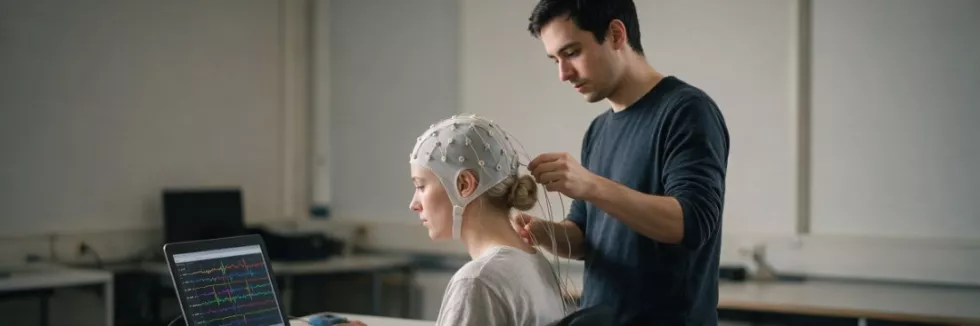
researchers-running-an-eeg-language-experiment-in-a-lab

10 questions · two minutes

1. A chatbot gives a fluent but completely wrong answer. What do you find most interesting about that?

2. How do you feel about designing a psycholinguistic experiment, for example measuring how quickly people read ambiguous sentences?

3. Would you learn to process language data in Python – splitting texts into tokens, counting patterns, training simple models?

4. Which question would you most like to explore in your thesis?

5. How do you feel about reading philosophy of mind – debates about consciousness, meaning and whether machines can think?

6. A speech recognition system works poorly for people with certain accents. What would you do?

7. The programme is taught in English, and you’ll work on projects with students from many linguistic backgrounds. How do you see that?

8. How do you feel about statistics – mixed models, significance tests, effect sizes?

9. Which future role sounds most like you?

10. What motivates you most to pursue a Master’s degree in Language, Mind, Technology?

⇑Definitions and quotes

Language
Language is a system that consists of the development, acquisition, maintenance and use of complex systems of communication, particularly the human ability to do so; and a language is any specific example of such a system.
Mind
The mind is a set of cognitive faculties including consciousness, perception, thinking, judgement, language and memory. It is usually defined as the faculty of an entity's thoughts and consciousness. It holds the power of imagination, recognition, and appreciation, and is responsible for processing feelings and emotions, resulting in attitudes and actions.
Technology
Technology ("science of craft", from Greek τέχνη, techne, "art, skill, cunning of hand"; and -λογία, -logia) is first robustly defined by Jacob Bigelow in 1829 as: "...principles, processes, and nomenclatures of the more conspicuous arts, particularly those which involve applications of science, and which may be considered useful, by promoting the benefit of society, together with the emolument [compensation ] of those who pursue them" .
Mind
If you think about it, the inside of your own mind is the only thing you can be sure of.
Thomas Nagel, What Does It All Mean?: A Very Short Introduction to Philosophy (1987), Ch. 2. How Do We Know Anything?
Technology
To appeal to contemporary man to revert, in this twentieth century, to a pagan-like nature worship in order to restrain technology from further encroachment and devastation of the resources of nature, is a piece of atavistic nonsense.
Norman Lamm, Faith and Doubt (1971).
Technology
There is a demon in technology. It was put there by man and man will have to exorcise it before technological civilization can achieve the eighteenth-century ideal of humane civilized life.
René Dubos, A God Within (1972), 216.
StudentNews Group Websites for students and future students across Europe — since 2003. Over 50 websites and millions of users a year (Google Analytics). Studies in Europe Universities in Europe Bachelor’s Master’s Doctorate MBA Study guide Work abroad Travel For partners Advertising and cooperation Reach (online report) Contact advertising@studentnews.eu © 2003–2026 Grupa StudentNews.pl sp. z o.o., Modlnica, Poland
Privacy Policy