Poznań, Poland

Geohazards and Climate Change

Master's
Table of contents
siberia-winter-river-shuryshkary

⇑Geohazards and Climate Change at UAM

Language: EnglishStudies in English
Subject area: physical science, environment
Kind of studies: full-time studies
University website: international.amu.edu.pl

⇑Test: Is Geohazards and Climate Change the right fit for you?

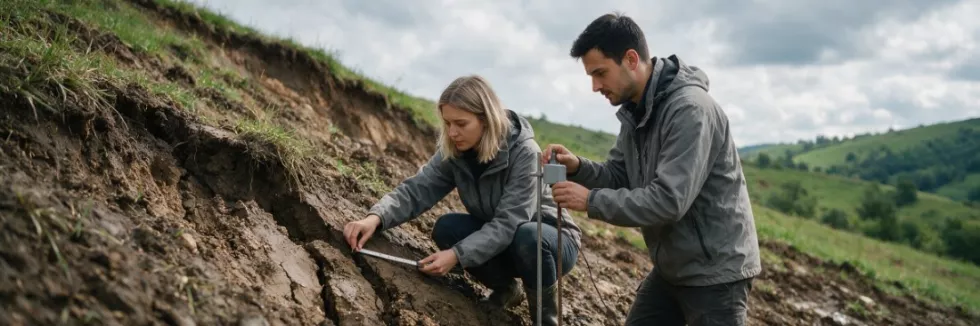
geoscientists-monitoring-a-landslide-on-a-hillside

10 questions · two minutes

1. You’re asked to map landslide susceptibility for a hilly region. How do you approach it?

2. Climate projections for the same area give quite different results. What do you do?

3. Local officials ask you to explain flood risk at a public meeting. How do you feel?

4. After a heavy storm, you join a field team to document slope failures. How does that sound?

5. How do you feel about designing an early warning system with sensors and real-time data?

6. Coastal erosion and thawing permafrost are accelerating. How does this topic make you feel?

7. You’ll work with engineers, planners and social scientists on one project. How do you see that?

8. The Master’s is taught in English, in a group from many countries. How do you feel about that?

9. Which role sounds most like your future?

10. What motivates you most to pursue a Master’s degree in Geohazards and Climate Change?

⇑Definitions and quotes

Climate
Climate is the statistics of weather over long periods of time. It is measured by assessing the patterns of variation in temperature, humidity, atmospheric pressure, wind, precipitation, atmospheric particle count and other meteorological variables in a given region over long periods of time. Climate differs from weather, in that weather only describes the short-term conditions of these variables in a given region.
Climate Change
Climate change is a change in the statistical distribution of weather patterns when that change lasts for an extended period of time (i.e., decades to millions of years). Climate change may refer to a change in average weather conditions, or in the time variation of weather within the context of longer-term average conditions. Climate change is caused by factors such as biotic processes, variations in solar radiation received by Earth, plate tectonics, and volcanic eruptions. Certain human activities have been identified as primary causes of ongoing climate change, often referred to as global warming.
StudentNews Group Websites for students and future students across Europe — since 2003. Over 50 websites and millions of users a year (Google Analytics). Studies in Europe Universities in Europe Bachelor’s Master’s Doctorate MBA Study guide Work abroad Travel For partners Advertising and cooperation Reach (online report) Contact advertising@studentnews.eu © 2003–2026 Grupa StudentNews.pl sp. z o.o., Modlnica, Poland
Privacy Policy