
Olsztyn, Poland

Environmental Engineering

Master's
Table of contents
Environmental Engineering study

⇑Environmental Engineering at UWM

Language: EnglishStudies in English
Subject area: physical science, environment
Kind of studies: full-time studies
  • Description:

  • pl

⇑Why study Environmental Engineering (Master's) at UWM in Olsztyn?

Dlaczego warto studiować na UWM w Olsztynie
Why study it:

At the University of Warmia and Mazury in Olsztyn, the Master's level of Environmental Engineering is taught in English through two three-semester specialisations run by the Faculty of Geoengineering. It is aimed at graduates who want to specialise in biological or process-based solutions to environmental problems.

Programme: real-world environmental projects

Across both specialisations you work on real-world projects alongside lectures and laboratory classes. You tackle environmental challenges with modern technologies and learn to apply advanced research techniques to assess the state of natural systems. The knowledge you gain prepares you for careers in industry as well as in academia.

Specialisation: two English-taught specialisations

Environmental Biotechnology focuses on how biology can solve environmental challenges. You study environmental monitoring and statistics, genetic and molecular techniques, bioenergy and bioplastics, biological wastewater treatment, bioprocess design, environmental toxicology and advanced IT tools, and the degree awarded is Master of Environmental Engineering.

Process Engineering and Environmental Protection is a joint programme with Offenburg University of Applied Sciences in Germany. Graduates receive two MSc diplomas, one from each university.

Labs: lab-based learning

In Environmental Biotechnology you learn by doing: you conduct laboratory experiments, analyse environmental samples and collaborate on live research projects with active researchers, in modern laboratories.

Exchanges: a semester in Germany

On the joint programme with Offenburg you spend one semester in Olsztyn and one in Germany. The third semester is devoted to your Master's thesis, which you complete at either university or externally at a company or research institution.

After graduation: careers and further study

Graduates of the two specialisations are prepared to work in:

  • environmental agencies;
  • biotechnology companies;
  • the renewable energy sector;
  • research institutions, and many graduates go on to PhD studies;
  • industry and academia.

Based on the programme pages at uwm.edu.pl.

Updated: 06.11.2026
⇑Test: Is Environmental Engineering the right fit for you?

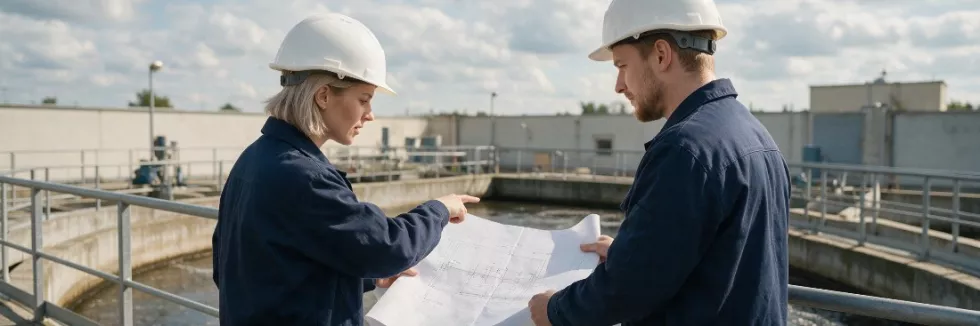
environmental-engineers-reviewing-plans-at-treatment-plant-test

10 questions · two minutes
1. You’re asked to design an upgrade of a wastewater treatment plant for a growing town. How do you start?

2. How comfortable are you with numerical modelling, such as groundwater flow or air pollution dispersion?

3. A project has to balance environmental targets, a tight budget and residents’ objections. What do you do?

4. Would you like to write a thesis on, for example, recovering energy from sewage sludge or removing micropollutants from water?

5. The programme is taught in English, and your classmates are engineers from different countries who know different regulations and technologies. How do you see that?

6. Your stormwater design is rejected at a regulatory review. How do you respond?

7. How do you feel about life cycle assessment and carbon footprint calculations?

8. Would you like to lead a team of engineers on an infrastructure project?

9. Nature-based solutions and smart water networks are gaining ground. How do you react?

10. What motivates you most to pursue a Master’s degree in Environmental Engineering?

⇑Definitions and quotes

Engineering
Engineering is the creative application of science, mathematical methods, and empirical evidence to the innovation, design, construction, operation and maintenance of structures, machines, materials, devices, systems, processes, and organizations. The discipline of engineering encompasses a broad range of more specialized fields of engineering, each with a more specific emphasis on particular areas of applied mathematics, applied science, and types of application. See glossary of engineering.
Engineering
When I looked at the science of engineering and saw that it had disappeared after its ancient heritage, that its masters have perished, and that their memories are now forgotten, I worked my wits and thoughts in secrecy about philosophical shapes and figures, which could move the mind, with effort, from nothingness to being and from idleness to motion. And I arranged these shapes one by one in drawings and explained them
Al-Muradi, The Book of Secrets in the Results of Ideas, 11th century; Translated and cited at leonardo3.net/bookofsecrets/index, 2015
Engineering
Engineering is the art of directing the great sources of power in nature for the use and convenience of man.
Thomas Tredgold (1828), used in the Royal Charter of the Institution of Civil Engineers (ICE) published in: The Times, London, article CS102127326, 30 June 1828.
Engineering
A good scientist is a person with original ideas. A good engineer is a person who makes a design that works with as few original ideas as possible. There are no prima donnas in engineering.
Freeman Dyson in Freeman J. Dyson. Disturbing the universe. Harper & Row. ISBN 978-0-06-090771-6. 

Contact:

ul. Michała Oczapowskiego 2
10-719 Olsztyn
tel: +48 89 523 49 13
StudentNews Group Websites for students and future students — in Poland since 2007, across Europe since 2014. Over 50 websites and millions of users a year (Google Analytics). Studies in Europe Universities in Europe Bachelor’s Master’s Doctorate MBA Study guide Work abroad Travel For partners Advertising and cooperation Reach (online report) Contact advertising@studentnews.eu © 2003–2026 Grupa StudentNews.pl sp. z o.o., Modlnica, Poland
Privacy Policy