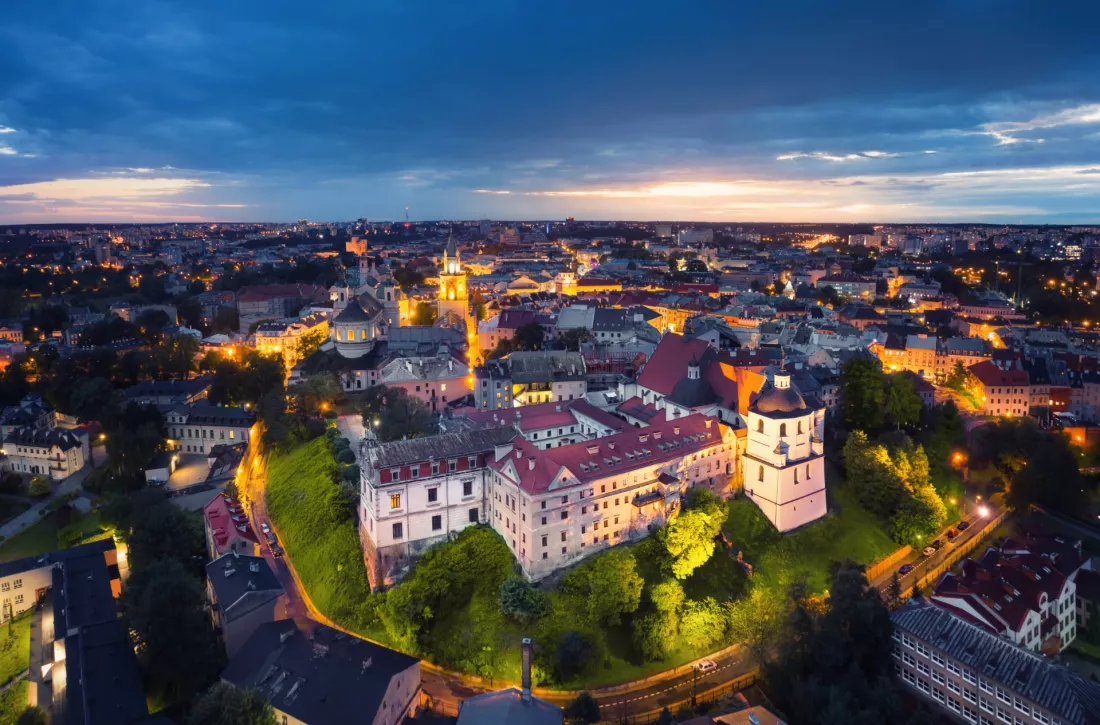


Lublin, Poland

International Relations

Bachelor's
Table of contents
conceptual-business-handshake-with-dashboard-financial-data-analysis

⇑International Relations at UMCS

Language: EnglishStudies in English
Subject area: economy and administration
Kind of studies: full-time studies
  • Description:

  • pl

⇑Why study International Relations at UMCS?

dlaczego-warto-studiowac-na-UMCS
Why study it:

International Relations at Maria Curie-Skłodowska University in Lublin (UMCS) is a three-year, full-time Bachelor's programme with a general academic profile, taught in English at the Faculty of Political Science and Journalism. It is for those who want to understand a fast-changing world – relations between states, international organisations and non-state actors, and the processes that shape the international environment.

Programme: many dimensions, many levels

The curriculum treats international relations as cross-border activities and processes that are multi-faceted – political, economic, social, cultural, military and ecological – and multi-level, from the global and regional scale down to individual countries. Throughout the programme the focus is on change: how the international order is shifting, how globalisation and cyberspace reduce the role of distance, and how what is global connects with what is local. Besides the core courses, you choose from a range of optional subjects.

Specialisation: global economy or regional studies

You can choose one of three specialisations:

  • Global Economy
  • Regional Studies – Central East Europe
  • Regional Studies – Asia and Pacific

Placements: internships, study trips and meetings

The programme offers domestic and foreign apprenticeships and internships, as well as study trips to state institutions dealing with foreign policy and to international organisations.

You also meet people from politics, diplomacy, the media and culture, can develop your interests in scientific clubs and take part in Oxford-style debates. Trainings and courses run by the UMCS Competence Development Office and the Academic Incubator of Entrepreneurship, where you can develop your own ideas, complete the picture.

Exchanges: Erasmus and visiting professors

Studies are international in both directions: at UMCS you attend classes with visiting professors and foreign lecturers from around the world, and through the Erasmus programme you can spend part of your studies at one of the partner universities abroad.

Did you know? Teaching on the programme draws on the research tradition at UMCS known as the “Lublin school of international relations”.

As of the 2026/27 admissions, based on the programme pages at irk.umcs.pl.

⇑Test: find out if International Relations is the right direction for you!

International Relations test

Find Out if International Relations Is the Right Path for You!

1. How engaged are you with international news and developments?

2. Can you dissect and understand conflicts between nations?

3. How crucial do you consider negotiation skills in international contexts?

4. How adept are you at communicating across cultures?

5. Does exploring the history of international relations excite you?

6. How confident are you in conducting research and using academic sources?

7. Do you excel at critical thinking and constructing arguments?

8. What level of foreign language proficiency and cultural awareness do you have?

9. Are you drawn to shaping international policies and strategies?

10. What motivates you most about studying International Relations?

⇑Definitions and quotes

International
International mostly means something (a company, language, or organization) involving more than a single country. The term international as a word means involvement of, interaction between or encompassing more than one nation, or generally beyond national boundaries. For example, international law, which is applied by more than one country and usually everywhere on Earth, and international language which is a language spoken by residents of more than one country.
International Relations
International Relations (IR) or International Affairs (IA) - commonly also referred to as International Studies (IS) or Global Studies (GS) - is the study of interconnectedness of politics, economics and law on a global level. Depending on the academic institution, it is either a field of political science, an interdisciplinary academic field similar to global studies, or an entirely independent academic discipline in which students take a variety of internationally focused courses in social science and humanities disciplines. In all cases, the field studies relationships between political entities (polities) such as sovereign states, inter-governmental organizations (IGOs), international non-governmental organizations (INGOs), other non-governmental organizations (NGOs), and multinational corporations (MNCs), and the wider world-systems produced by this interaction. International relations is an academic and a public policy field, and so can be positive and normative, because it analyses and formulates the foreign policy of a given state.
International Relations
The most dangerous states in the international system are continental powers with large armies.
John Mearsheimer, The Tragedy of Great Power Politics (2001).
International Relations
The bipolar world is over, but it not going to be replaced by a unipolar world empire that the United States controls alone. The world is already economically multipolar, and there will be a diffusion of power as the information revolution progresses, interdependence increases, and transnational actors become more important. The new world will not be neat, and you will have to live with that.
Joseph Samuel Nye, Jr.,Understanding International Conflicts - An Introduction to Theory and History (Sixth Edition).
International Relations
Offensive realism predicts that the United States will send its army across the Atlantic when there is a potential hegemon in Europe that the local great powers cannot contain by themselves.
John Mearsheimer, The Tragedy of Great Power Politics (2001).

Contact:

Pl. Marii Curie-Sklodowskiej 5
20-031 Lublin
Department of Education
International Students Office
phone: (+48) 81 537 29 26
facebook International Student Office


Privacy Policy