

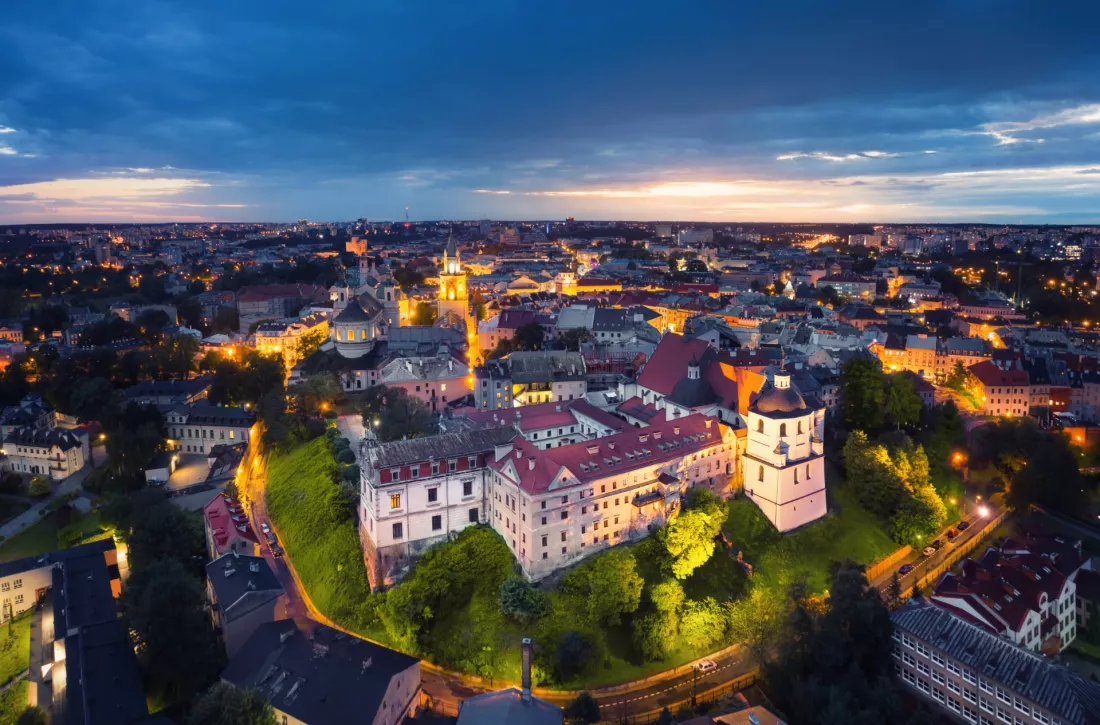
Lublin, Poland

Intercultural Communication in Education and The Workplace

Master's
Table of contents
farzad-mohsenvand-pKhfJme9mP0-unsplash

⇑Intercultural Communication in Education and The Workplace at UMCS

Language: EnglishStudies in English
Subject area: teacher training and education science
Kind of studies: full-time studies
  • Description:

  • pl
University website: www.umcs.pl/en

⇑Why study Intercultural Communication in Education and the Workplace (Master's) at UMCS?

dlaczego-warto-studiowac-na-UMCS
Why study it:

Intercultural Communication in Education and the Workplace at Maria Curie-Skłodowska University in Lublin (UMCS) is a two-year, full-time Master's programme with a general academic profile, taught in English at the Faculty of Philology. It is designed both for Polish students who want to study in English in an international environment and for foreign students looking for an English-taught MA in Poland.

Programme: four thematic blocks

The curriculum is built around four blocks: cultural studies, relations between language and culture, practical learning of a foreign language, and preparation for writing a Master's thesis. Along the way you study cultural anthropology, the dynamics of cultural phenomena, multilingualism and the adaptation difficulties people face in a multicultural environment.

The programme looks at intercultural communication in schools and at work. You study national and ethnic minorities, non-verbal communication in an intercultural context and multicultural problems in an era of global economic and educational migration, and you learn to research multicultural and multilingual settings.

Languages: English plus a second foreign language

Languages at a glance

  • Language of instructionEnglish
  • English on graduationlevel B2+ or C1
  • Second foreign languageminimum level A2
  • Focusreceptive and expressive communication skills related to the job market

After graduation: education and international workplaces

Graduates gain the knowledge needed to function on the international job market and qualifications to teach subjects related to multiculturalism in the contemporary world.

Practical oral and written language skills, intercultural competence – including its non-verbal side – and an attitude of respect and openness towards other cultures prepare you to work in educational institutions and on the international job market, and to carry out research in multilingual environments.

As of the 2026/27 admissions, based on the programme pages at irk.umcs.pl.

⇑Test: Is Intercultural Communication in Education and The Workplace the right fit for you?

trainer-leading-an-intercultural-communication-workshop

10 questions · two minutes
1. A team member from another culture never disagrees openly in meetings. How do you interpret it?

2. You’re asked to design a workshop for teachers whose classes include newly arrived pupils. How do you react?

3. How do you feel about studying theories of culture, identity and communication?

4. A misunderstanding between two departments with staff from different backgrounds is causing tension. What would you do?

5. Would you like to carry out a research project, such as interviews with international employees about their experiences?

6. The programme is taught in English, in a group of students from many countries. How do you see that?

7. A company asks you to prepare employees for a long-term assignment abroad. What would you include?

8. How do you react when your own cultural habits are questioned?

9. Which future role sounds most like you?

10. What motivates you most to pursue a Master’s degree in Intercultural Communication in Education and The Workplace?

⇑Definitions and quotes

Communication
Communication (from Latin commūnicāre, meaning "to share") is the act of conveying intended meanings from one entity or group to another through the use of mutually understood signs and semiotic rules.
Education
Education is the process of facilitating learning, or the acquisition of knowledge, skills, values, beliefs, and habits. Educational methods include storytelling, discussion, teaching, training, and directed research. Education frequently takes place under the guidance of educators, but learners may also educate themselves. Education can take place in formal or informal settings and any experience that has a formative effect on the way one thinks, feels, or acts may be considered educational. The methodology of teaching is called pedagogy.
Intercultural Communication
Intercultural communication is a discipline that studies communication across different cultures and social groups, or how culture affects communication. It is used to describe the wide range of communication processes and problems that naturally appear within an organization or social context made up of individuals from different religious, social, ethnic, and educational backgrounds. Intercultural communication is sometimes used synonymously with cross-cultural communication. In this sense it seeks to understand how people from different countries and cultures act, communicate and perceive the world around them. Many people in intercultural business communication argue that culture determines how individuals encode messages, what medium they choose for transmitting them, and the way messages are interpreted.
Education
Impartially their talents scan,
Just education forms the man.
John Gay, The Owl, Swan, Cock, Spider, Ass, and the Farmer. To a Mother, line 9.
Education
If today you can take a thing like evolution and make it a crime to teach it in the public school, tomorrow you can make it a crime to teach it in the private schools, and the next year you can make it a crime to teach it to the hustings or in the church. At the next session you may ban books and the newspapers. Soon you may set Catholic against Protestant and Protestant against Protestant, and try to foist your own religion upon the minds of men. If you can do one you can do the other. Ignorance and fanaticism is ever busy and needs feeding. Always it is feeding and gloating for more. Today it is the public school teachers, tomorrow the private. The next day the preachers and the lectures, the magazines, the books, the newspapers. After a while, your honor, it is the setting of man against man and creed against creed until with flying banners and beating drums we are marching backward to the glorious ages of the sixteenth century when bigots lighted fagots to burn the men who dared to bring any intelligence and enlightenment and culture to the human mind.
Clarence Darrow Scopes Trial, Dayton, Tennessee (13 July 1925)
Education
Parents thought it was enough to bring their children into the world and to shower them with riches, but had no interest in their education. There are severe laws against people who expose their children and abandon them in some forest to be devoured by wild animals. But is there any form of exposure more cruel than to abandon to bestial impulses children whom nature intended to be raised according to upright principles to live a good life? If there existed a Thessalian witch who had the power and the desire to transform your son into a swine or a wolf, would you not think that no punishment could be too severe for her? But what you find revolting in her, you eagerly practise yourself. Lust is a hideous brute; extravagance is a devouring and insatiable monster; drunkenness is a savage beast; anger is a fearful creature; and ambition is a ghastly animal. Anyone who fails to instil into his child, from his earliest years onwards, a love of good and a hatred of evil is, in fact, exposing him to these cruel monsters.
Erasmus, “On Education for Children,” The Erasmus Reader (University of Toronto Press: 1990), p. 74

Contact:

Pl. Marii Curie-Sklodowskiej 5
20-031 Lublin
Department of Education
International Students Office
phone: (+48) 81 537 29 26
facebook International Student Office


Privacy Policy