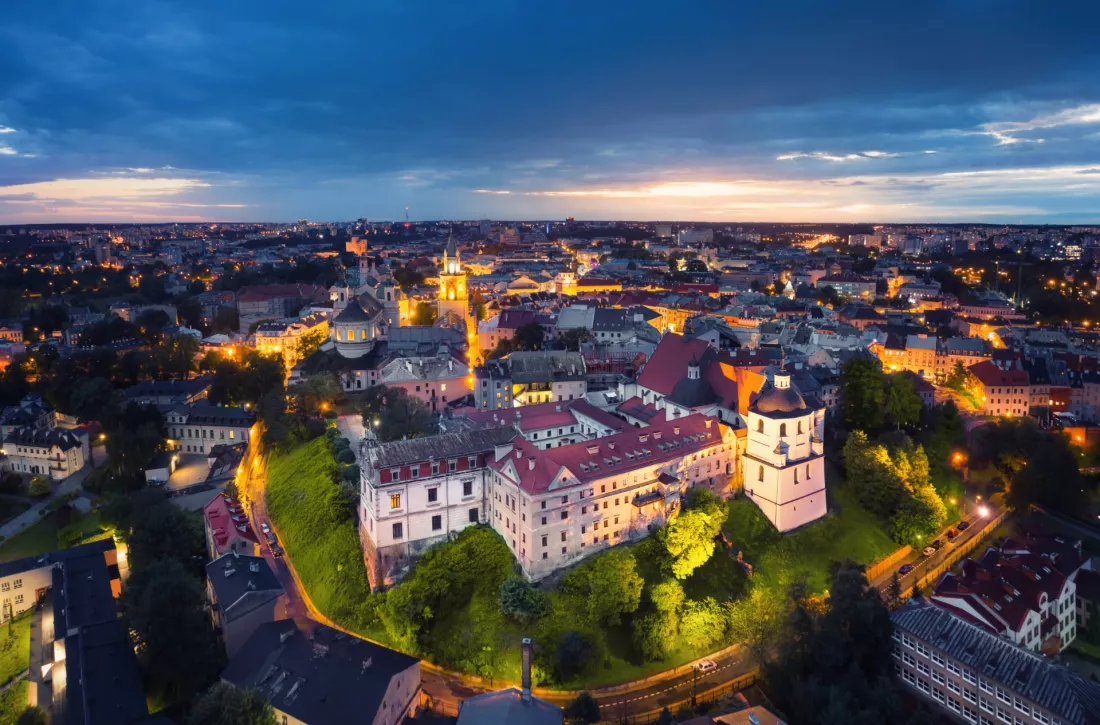

Lublin, Poland

Chemistry

Master's
Table of contents
hans-reniers-lQGJCMY5qcM-unsplash

⇑Chemistry at UMCS

Language: EnglishStudies in English
Subject area: physical science, environment
Kind of studies: full-time studies
  • Description:

  • pl
Specialities:
University website: www.umcs.pl/en

⇑Why study Chemistry (Master's) at UMCS?

dlaczego-warto-studiowac-na-UMCS
Why study it:

Chemistry at Maria Curie-Skłodowska University in Lublin (UMCS) is a two-year, full-time Master's programme with a general academic profile, taught in English at the Faculty of Chemistry. It is designed for Bachelor's graduates in chemistry or related disciplines who want to deepen their knowledge of chemistry and of their chosen specialisation.

Specialisation: Materials Chemistry

The programme runs as the Materials Chemistry specialisation. Alongside it, you develop the skills to solve chemical problems – also in non-standard situations – to form opinions from incomplete or limited information within legal and ethical principles, to discuss chemistry with both specialists and non-specialists, and to lead teamwork.

Qualifications: Chemistry Euromaster® accreditation

The second-cycle Chemistry programme holds the international Chemistry Euromaster® accreditation awarded by the European Chemistry Thematic Network Association (ECTN).

After graduation: industry, administration, research

Graduates are prepared to work in the chemical industry and related areas, as well as in state and municipal administration. After completing a teaching specialty, they can also work in education.

If you are drawn to research, the Master's degree prepares you to take up research challenges and continue at doctoral level.

As of the 2026/27 admissions, based on the programme pages at irk.umcs.pl.
⇑Test: check whether Chemistry is the right major for you!

Chemiaf

Answer all questions to see if a Master's in Chemistry is the right next step for you!

1. Do you want to deepen your understanding of molecular structure, reaction mechanisms, and chemical theory?

2. Are you interested in gaining advanced laboratory skills like spectroscopy, chromatography, or synthesis techniques?

3. Do you want to engage in research on areas such as materials chemistry, medicinal chemistry, environmental chemistry, or catalysis?

4. Are you willing to participate in interdisciplinary projects involving chemistry and fields like biology, physics, or engineering?

5. Do you believe that a two-year master's in Chemistry will significantly enhance your research skills or career prospects in industry/academia?

6. Are you interested in learning how to apply computational chemistry, modeling, or data analysis to chemical problems?

7. Do you value ethical and sustainable practices in chemistry, such as green chemistry, safe handling of chemicals, and reproducibility?

8. Are you motivated to apply chemical knowledge to real-world challenges like drug development, energy materials, or environmental remediation?

9. Are you comfortable collaborating with chemists, biologists, engineers, and data scientists to solve complex problems?

10. What motivates you most to pursue a Master’s in Chemistry?

⇑Definitions and quotes

Chemistry
Chemistry is the scientific discipline involved with compounds composed of atoms, i.e. elements, and molecules, i.e. combinations of atoms: their composition, structure, properties, behavior and the changes they undergo during a reaction with other compounds. Chemistry addresses topics such as how atoms and molecules interact via chemical bonds to form new chemical compounds. There are four types of chemical bonds: covalent bonds, in which compounds share one or more electron(s); ionic bonds, in which a compound donates one or more electrons to another compound to produce ions (cations and anions); hydrogen bonds; and Van der Waals force bonds.
Chemistry
I praise the chemical physicians, for they do not go about gorgeous in satins, silks, and velvets, silver daggers hanging at their sides, and white gloves on their hands, but they tend their work at the fire patiently day and night. They do not go promenading, but seek their recreation in laboratory. They thrust their fingers among the coals into dirt and rubbish and not into golden rings.
Paracelsus (in Jaffe, Bernard. Crucibles: The Story of Chemistry. 4th Edition. New York: Dover, 1976. (Originally, 1930) | Pgs. 13-24)
Chemistry
We may, I believe, anticipate that the chemist of the future who is interested in the structure of proteins, nucleic acids, polysaccharides, and other complex substances with high molecular weight will come to rely upon a new structural chemistry, involving precise geometrical relationships among the atoms in the molecules and the rigorous application of the new structural principles, and that great progress will be made, through this technique, in the attack, by chemical methods, on the problems of biology and medicine.
Linus Pauling, Nobel Lecture (11 December 1954)
Chemistry
You don't need something more to get something more. That's what emergence means. Life can emerge from physics and chemistry plus a lot of accidents. The human mind can arise from neurobiology and a lot of accidents, the way the chemical bond arises from physics and certain accidents. Doesn't diminish the importance of these subjects to know they follow from more fundamental things plus accidents.
Murray Gell-Mann (2007) TED talk on beauty and truth in physics — video TC 14m48s (March 2007)

Contact:

Pl. Marii Curie-Sklodowskiej 5
20-031 Lublin
Department of Education
International Students Office
phone: (+48) 81 537 29 26
facebook International Student Office


Privacy Policy