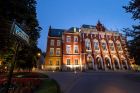
Cracow, Poland

Una Europe Joint Bachelor in Sustainability (BASUS)

Bachelor's
Table of contents

Una Europe Joint Bachelor in Sustainability (BASUS) at UJ

Language: EnglishStudies in English
Kind of studies: full-time studies
  • Description:

  • pl

Definitions and quotes

Europe
Europe is a continent located entirely in the Northern Hemisphere and mostly in the Eastern Hemisphere. It is bordered by the Arctic Ocean to the north, the Atlantic Ocean to the west, and the Mediterranean Sea to the south. It comprises the westernmost part of Eurasia.
Sustainability
Sustainability (from 'sustain' and 'ability') is the process of change, in which the exploitation of resources, the direction of investments, the orientation of technological development and institutional change are all in harmony and enhance both current and future potential to meet human needs and aspirations. The organizing principle for sustainability is sustainable development, which includes the following interconnected domains: environment, economic and social. Sub-domains of sustainable development have been considered also: cultural, technological and political. Sustainable development, is the development that meets the needs of the present without compromising the ability of future generations to meet their own needs. Brundtland Report for the World Commission on Environment and Development (1992) introduced the term of sustainable development.
Europe
The USA will remain the only superpower. China is becoming an economic giant. Europe is being Islamicized.
Frits Bolkestein, address at the opening of courses at the University of Leiden (2004), as quoted in "Islamic Europe?" (4 October 2004), by Christopher Caldwell, The Weekly Standard

Europe
Soon nostalgia will be another name for Europe.
Angela Carter (1940–92), British postmodern novelist. repr. Vintage (1992). Expletives Deleted, review of John Berger, Once in Europa, The Washington Post (1989)
Sustainability
Cybernetics is a young discipline which, like applied mathematics, cuts across the entrenched departments of natural science; the sky, the earth, the animals and the plants. Its interdisciplinary character emerges when it considers economy not as an economist, biology not as a biologist, engines not as an engineer. In each case its theme remains the same, namely, how systems regulate themselves, reproduce themselves, evolve and learn. Its high spot is the question of how they organize themselves.
A cybernetic laboratory has a varied worksheet - concept formation in organized groups, teaching machines, brain models, and chemical computers for use in a cybernetic factory. As pure scientists we are concerned with brain-like artifacts, with evolution, growth and development; with the process of thinking and getting to know about the world. Wearing the hat of applied science, we aim to create what Boulanger,' in his presidential address to the International Association of Cybernetics, called the instruments of a new industrial revolution - control mechanisms that lay their own plans.
Gordon Pask An Approach to Cybernetics (1961). p. 11. Partly cited in: A.M.E. Salazar, A. Espinosa, J. Walker (2011) A Complexity Approach to Sustainability: Theory and Application. p. 11.

Contact:

phone (+48 12) 663 11 00
Gołębia str. 24
31-007 Kraków
Privacy Policy