Cracow, Poland

Food Engineering

Master's
Table of contents
Food Engineering study

Food Engineering at URK

Language: EnglishStudies in English
Subject area: agriculture, forestry and fishery, veterinary
Kind of studies: full-time studies

Why study Food Engineering at URK?

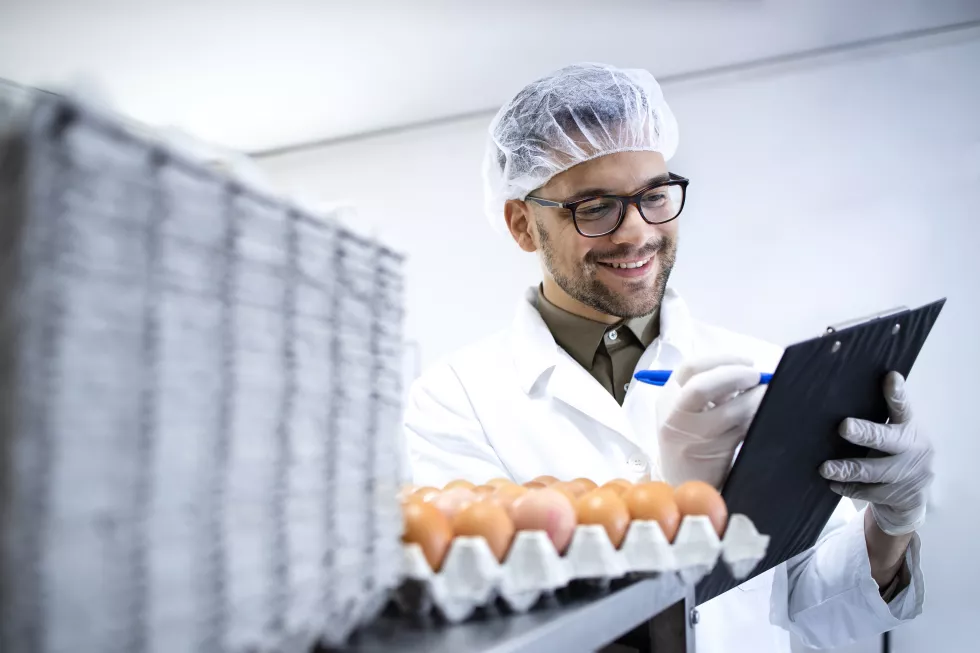
food-factory-worker-white-coat-hairnet-hygienic-gloves-controlling-eggs-production-food-processing-plant
Why It's Worth It:

Advanced Engineering in Food Production

The Food Engineering specialization at URK provides a robust academic foundation for those looking to master the technical side of food manufacturing. By merging classical engineering principles with modern biological sciences, the program prepares students to design and oversee sophisticated production systems. This specialization is ideal for individuals who want to lead the technological transformation of the global food industry within the Faculty of Food Technology.

Mastering Process Engineering Principles

The curriculum focuses heavily on unit operations that are essential for large-scale food processing, such as thermal treatment, dehydration, and mechanical separation. Students at URK analyze the physical and chemical transformations that occur during these processes to ensure maximum efficiency. This technical expertise allows future engineers to optimize production lines, ensuring that food products maintain their nutritional value while being produced at an industrial scale.

Innovation in Machinery and Plant Design

A significant part of the educational path involves the design and maintenance of specialized equipment used in the food sector. Participants learn how to select appropriate construction materials and implement sanitary design principles to prevent contamination. This focus on infrastructure ensures that graduates can contribute to the development of modern processing plants that meet the highest international standards of safety and hygiene.

Integration of Automation and Industry 4.0

As the industry shifts toward digital transformation, this specialization incorporates advanced topics in automation and process control. Students gain hands-on experience with sensors, programmable logic controllers, and data analysis tools used to monitor production in real-time. By mastering these digital skills, graduates are prepared to implement "smart factory" solutions that increase precision and reduce waste in the food supply chain.

Sustainable Technological Solutions

The university emphasizes the importance of resource efficiency and environmental stewardship in modern engineering. Students explore methods to reduce water consumption and optimize energy use within processing facilities. By learning how to recover waste heat and repurpose agricultural by-products, future engineers are equipped to build more sustainable production models that align with the global goals of a circular bio-economy.

Food Safety and Quality Systems

Engineering excellence is directly linked to the safety of the final product. The program integrates technical training with rigorous quality management systems, teaching students how to identify and mitigate risks throughout the manufacturing process. This comprehensive approach ensures that every technological innovation is balanced with strict adherence to health regulations and consumer protection standards.

Research and Development Capabilities

The specialization fosters a culture of innovation, encouraging students to engage in research and development projects. They have the opportunity to test emerging technologies, such as high-pressure processing or advanced membrane filtration, in well-equipped laboratory settings. This focus on R&D prepares graduates to work in experimental departments where new food products and processing methods are conceptualized and tested.

Global Career Opportunities in Engineering

Graduates of the Food Engineering specialization are highly valued in the international job market, finding roles as production managers, process engineers, and technical consultants. Their ability to speak the language of both science and engineering makes them indispensable in multinational food corporations and technology providers. With a degree from this prestigious institution, alumni are ready to solve complex technical challenges across the global food and beverage landscape.


Test: Is Food Engineering the right fit for you?

Food Engineering test

Answer all the questions and check if Food Engineering is the right Master’s programme for you!

1. Do you want to deepen your knowledge in food processing and innovative technologies?

2. Are you interested in designing and improving food production systems?

3. Do you want to develop skills in food quality and safety management?

4. Are you ready to participate in research projects on new food materials and biotechnologies?

5. Will investing two more years in a Master’s degree increase your competitiveness in the food industry?

6. Do you want to specialise in sustainable food production and environmental protection?

7. Are you motivated to improve your engineering competences for work in international food companies?

8. Do you want to gain expertise in packaging, storage and logistics of food products?

9. Are you ready to work in interdisciplinary teams with technologists, engineers and biologists?

10. What motivates you most to pursue a Master’s degree in Food Engineering?

Definitions and quotes

Engineering
Engineering is the creative application of science, mathematical methods, and empirical evidence to the innovation, design, construction, operation and maintenance of structures, machines, materials, devices, systems, processes, and organizations. The discipline of engineering encompasses a broad range of more specialized fields of engineering, each with a more specific emphasis on particular areas of applied mathematics, applied science, and types of application. See glossary of engineering.
Food
Food is any substance consumed to provide nutritional support for an organism. It is usually of plant or animal origin, and contains essential nutrients, such as carbohydrates, fats, proteins, vitamins, or minerals. The substance is ingested by an organism and assimilated by the organism's cells to provide energy, maintain life, or stimulate growth.
Food Engineering
Food engineering is a multidisciplinary field which combines microbiology, applied physical sciences, chemistry and engineering for food and related industries. Food engineering includes, but is not limited to, the application of agricultural engineering, mechanical engineering and chemical engineering principles to food materials. Food engineers provide the technological knowledge transfer essential to the cost-effective production and commercialization of food products and services. Physics, chemistry, and mathematics are fundamental to understanding and engineering products and operations in the food industry.
Engineering
When I looked at the science of engineering and saw that it had disappeared after its ancient heritage, that its masters have perished, and that their memories are now forgotten, I worked my wits and thoughts in secrecy about philosophical shapes and figures, which could move the mind, with effort, from nothingness to being and from idleness to motion. And I arranged these shapes one by one in drawings and explained them
Al-Muradi, The Book of Secrets in the Results of Ideas, 11th century; Translated and cited at leonardo3.net/bookofsecrets/index, 2015
Engineering
These experiences are not 'religious' in the ordinary sense. They are natural, and can be studied naturally. They are not 'ineffable' in the sense the sense of incommunicable by language. Maslow also came to believe that they are far commoner than one might expect, that many people tend to suppress them, to ignore them, and certain people seem actually afraid of them, as if they were somehow feminine, illogical, dangerous. 'One sees such attitudes more often in engineers, in mathematicians, in analytic philosophers, in book keepers and accountants, and generally in obsessional people'.
The peak experience tends to be a kind of bubbling-over of delight, a moment of pure happiness. 'For instance, a young mother scurrying around her kitchen and getting breakfast for her husband and young children. The sun was streaming in, the children clean and nicely dressed, were chattering as they ate. The husband was casually playing with the children: but as she looked at them she was suddenly so overwhelmed with their beauty and her great love for them, and her feeling of good fortune, that she went into a peak experience . . .
Colin Wilson in New Pathways In Psychology, p. 17
Engineering
Engineering is too important to wait for science.
Benoît Mandelbrot As quoted in "Fractal Finance" by Greg Phelan in Yale Economic Review (Fall 2005)

Contact:

Al. Mickiewicza 21
31-120 Kraków
tel. 12 662 43 34
Privacy Policy