Szczecin, Poland

Materials Science and Engineering

Bachelor's
Table of contents
Materials Science and Engineering study

⇑Materials Science and Engineering at ZUT

Language: EnglishStudies in English
Subject area: engineering and engineering trades
Kind of studies: full-time studies

⇑Test: Is Materials Science and Engineering the right fit for you?

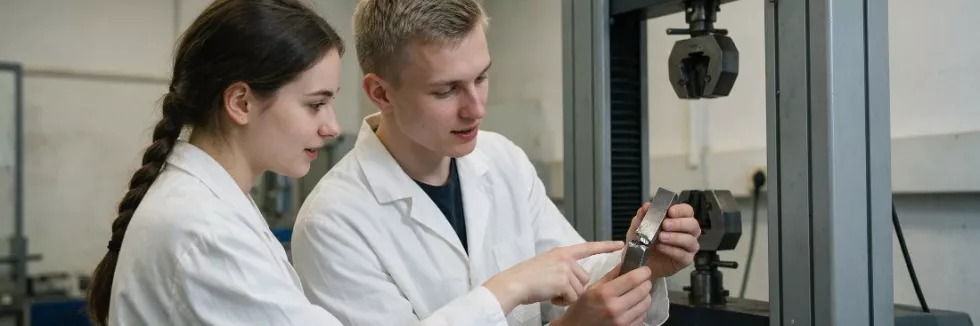
students-examining-a-broken-metal-sample-in-a-lab-test

10 questions · two minutes

1. Your phone screen cracked when you dropped it, but the case wasn’t even scratched. What do you wonder?

2. How do you feel about chemistry and physics at school?

3. Imagine a lab class where you test how much force a metal rod can take before it snaps. How does that sound?

4. You see a bicycle frame made of carbon fibre. What interests you?

5. Lectures, lab reports and project work will be in English, with students from different countries. How does that sound?

6. How patient are you when an experiment doesn’t work the first time?

7. Engineers are developing materials that can be fully recycled or that break down naturally. How do you feel about that kind of work?

8. Would you enjoy examining the inner structure of metals or plastics under a microscope?

9. During a summer job at a factory making metal parts, you notice some parts keep cracking. What do you do?

10. What motivates you most to study Materials Science and Engineering?

⇑Definitions and quotes

Engineering
Engineering is the creative application of science, mathematical methods, and empirical evidence to the innovation, design, construction, operation and maintenance of structures, machines, materials, devices, systems, processes, and organizations. The discipline of engineering encompasses a broad range of more specialized fields of engineering, each with a more specific emphasis on particular areas of applied mathematics, applied science, and types of application. See glossary of engineering.
Materials Science
The interdisciplinary field of materials science, also commonly termed materials science and engineering is the design and discovery of new materials, particularly solids. The intellectual origins of materials science stem from the Enlightenment, when researchers began to use analytical thinking from chemistry, physics, and engineering to understand ancient, phenomenological observations in metallurgy and mineralogy. Materials science still incorporates elements of physics, chemistry, and engineering. As such, the field was long considered by academic institutions as a sub-field of these related fields. Beginning in the 1940s, materials science began to be more widely recognized as a specific and distinct field of science and engineering, and major technical universities around the world created dedicated schools of the study, within either the Science or Engineering schools, hence the naming.
Science
Science (from Latin scientia, meaning "knowledge") is a systematic enterprise that builds and organizes knowledge in the form of testable explanations and predictions about the universe.
Science
We’ve arranged a global civilization in which most critical elements profoundly depend on science and technology. We have also arranged things so that almost no one understands science and technology. This is a prescription for disaster. We might get away with it for a while, but sooner or later this combustible mixture of ignorance and power is going to blow up in our faces.
Sir Ernest Rutherford from The Demon-Haunted World: Science as a Candle in the Dark (1996), 26.
Engineering
Engineering is the conscious application of science to the problem of economic production.
Halbert Powers Gillette (1910). cited in: T.J. Hoover & J.C. Lounsbury Fish. The Engineering Profession. Stanford University Press, 1941. p. 463
Engineering
These experiences are not 'religious' in the ordinary sense. They are natural, and can be studied naturally. They are not 'ineffable' in the sense the sense of incommunicable by language. Maslow also came to believe that they are far commoner than one might expect, that many people tend to suppress them, to ignore them, and certain people seem actually afraid of them, as if they were somehow feminine, illogical, dangerous. 'One sees such attitudes more often in engineers, in mathematicians, in analytic philosophers, in book keepers and accountants, and generally in obsessional people'.
The peak experience tends to be a kind of bubbling-over of delight, a moment of pure happiness. 'For instance, a young mother scurrying around her kitchen and getting breakfast for her husband and young children. The sun was streaming in, the children clean and nicely dressed, were chattering as they ate. The husband was casually playing with the children: but as she looked at them she was suddenly so overwhelmed with their beauty and her great love for them, and her feeling of good fortune, that she went into a peak experience . . .
Colin Wilson in New Pathways In Psychology, p. 17
StudentNews Group Websites for students and future students — in Poland since 2007, across Europe since 2014. Over 50 websites and millions of users a year (Google Analytics). Studies in Europe Universities in Europe Bachelor’s Master’s Doctorate MBA Study guide Work abroad Travel For partners Advertising and cooperation Reach (online report) Contact advertising@studentnews.eu © 2003–2026 Grupa StudentNews.pl sp. z o.o., Modlnica, Poland
Privacy Policy