Cracow, Poland

Additive Manufacturing

Master's
Table of contents
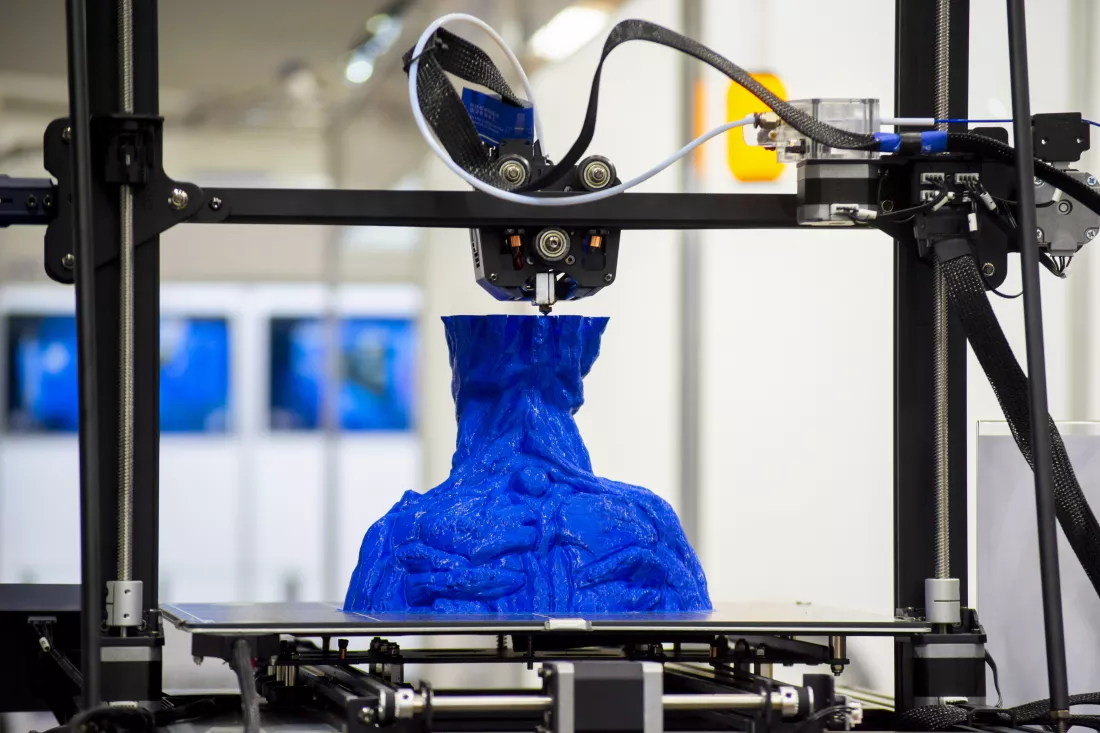
d-printer-printing-object-closeup-process-creating-threedimensional-model-d-printer-additive

⇑Additive Manufacturing at PK Kraków

Language: EnglishStudies in English
Subject area: engineering and engineering trades
Kind of studies: full-time studies

⇑Test: Is Additive Manufacturing the right fit for you?

engineers-inspecting-a-3d-printed-metal-part-test

10 questions · two minutes

1. A client needs a lightweight bracket with a shape that can’t be machined conventionally. How do you approach it?

2. A metal part made by laser powder bed fusion has cracked near its supports. What do you want to know?

3. How do you feel about the materials science side – microstructure, porosity and how alloys and polymers behave?

4. You’ll work on projects in English with engineers from different countries and industries. How does that sound?

5. A manufacturer asks whether switching a spare part to 3D printing makes business sense. What do you do?

6. Your Master’s thesis could examine how printing parameters affect fatigue strength. How do you react?

7. A medical company wants patient-specific implants. What do you think about first?

8. How do you approach CAD, simulation and slicing software?

9. A production run of printed parts shows inconsistent dimensions from one build to the next. What do you do?

10. What motivates you most to pursue a Master’s degree in Additive Manufacturing?

⇑Definitions and quotes

Manufacturing
Manufacturing is the production of merchandise for use or sale using labour and machines, tools, chemical and biological processing, or formulation. The term may refer to a range of human activity, from handicraft to high tech, but is most commonly applied to industrial production, in which raw materials are transformed into finished goods on a large scale. Such finished goods may be sold to other manufacturers for the production of other, more complex products, such as aircraft, household appliances, furniture, sports equipment or automobiles, or sold to wholesalers, who in turn sell them to retailers, who then sell them to end users and consumers.
Manufacturing
The two main purposes of mechanical engineering are: first, to design and make tools and equipment for turning out machinery required by all branches of engineering, industry, and commerce, and, second, to design and manufacture, by means of said tools and equipment.
Theodore Jesse Hoover, ‎John Charles Lounsbury Fish (1941) The Engineering Profession. p. 133
Manufacturing
Mechanical engineering may be defined as the manufacture, installation, and repair of all kinds of machinery (including machine tools), prime movers and boilers, and engines.
N. K. Buxton, ‎Derek Howard Aldcroft (1979) British industry between the wars. p. 129
Manufacturing
In short, intelligence, considered in what seems to be its original feature, is the faculty of manufacturing artificial objects, especially tools to make tools, and of indefinitely urging the manufacture.
Henri Bergson, Creative Evolution (1907), Chapter II
StudentNews Group Websites for students and future students — in Poland since 2007, across Europe since 2014. Over 50 websites and millions of users a year (Google Analytics). Studies in Europe Universities in Europe Bachelor’s Master’s Doctorate MBA Study guide Work abroad Travel For partners Advertising and cooperation Reach (online report) Contact advertising@studentnews.eu © 2003–2026 Grupa StudentNews.pl sp. z o.o., Modlnica, Poland
Privacy Policy