


Cracow, Poland

Sustainable Energy Systems

Master's
Table of contents
inzynierowie-sprawdzaja-kontenerowy-magazyn-energii

⇑Sustainable Energy Systems at AGH

Language: EnglishStudies in English
Subject area: engineering and engineering trades
Kind of studies: full-time studies
  • Description:

  • pl

⇑Why study Sustainable Energy Systems (Master's) at AGH?

dlaczego-warto-studiowac-na-AGH
Why study it:

Sustainable Energy Systems (SES) is a full-time Master's programme at AGH University of Krakow, taught in English and leading to the magister inżynier degree, with winter admissions. It is for engineers who want to work on the energy transition and combine technical knowledge with management, energy economics and climate policy.

Programme: renewables, hydrogen and system modelling

You will study, among other things:

  • renewable energy sources, hydrogen energy and energy storage technologies
  • integration of renewables with power systems and distributed energy networks
  • modelling, analysis and optimisation of energy systems
  • energy economics and policy, decarbonisation and sustainable development
  • modern project management methods

Placements: Challenge-Based Education with industry

Working with industry

  • FormatChallenge-Based Education courses built around real industrial problems
  • Partnerscompanies from the energy sector
  • Projects fore.g. Shell, TAURON, E.ON and EDF

Languages: English with international experts

All courses are taught in English by academic staff and international experts, so you get used to working in international project, research and consulting teams.

Exchanges: part of EIT InnoEnergy SELECT

SES is the result of long-term cooperation between AGH and European universities within the EIT InnoEnergy Master's School – MSc Environomical Pathways for Sustainable Energy Systems (SELECT). The programme places emphasis on international mobility and on preparing you for international academic and industrial environments.

After graduation: energy companies, agencies and research

After graduation you can design and implement energy transition solutions, assess the efficiency and environmental impact of energy processes, model energy systems with advanced digital tools, and run projects in decarbonisation, sector coupling and energy efficiency.

Graduates work in energy companies (generation, distribution, renewables, hydrogen, storage), engineering, consulting and technology firms, public administration and international organisations such as energy and climate agencies, research and development centres and universities, and start-ups.

As of the 2026/27 admissions, based on the programme page at rekrutacja.agh.edu.pl.
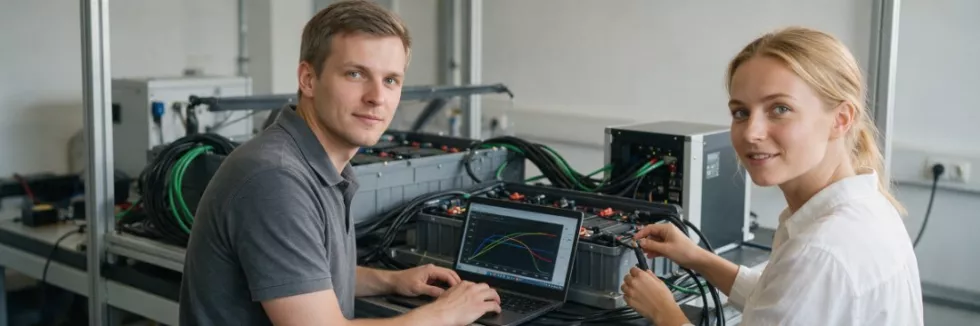
⇑Test: Is Sustainable Energy Systems the right fit for you?

engineers-testing-a-battery-storage-module-in-a-lab

10 questions · two minutes

1. You’re given hourly data on a solar installation’s output and a building’s energy consumption. What do you do with it?

2. More renewables are being connected to the grid, and the operator is reporting stability problems. How do you look for a solution?

3. How would you rate your grounding in maths, thermodynamics and electrical engineering?

4. Lectures, projects and technical reports will be in English, and your project teams will include engineers from different countries. How does that sound?

5. You have to design the energy supply for a new housing estate. What matters most to you?

6. You’re working in simulation software and a model result looks suspicious. What do you do?

7. How do you see energy efficiency in buildings and industry?

8. During an internship at an energy company, you’re given a task outside your speciality, such as an economic analysis of an investment. How do you react?

9. Where do you see yourself after graduating?

10. What motivates you most to pursue a Master’s degree in Sustainable Energy Systems?

⇑Definitions and quotes

Energy
In physics, energy is the quantitative property that must be transferred to an object in order to perform work on, or to heat, the object. Energy is a conserved quantity; the law of conservation of energy states that energy can be converted in form, but not created or destroyed. The SI unit of energy is the joule, which is the energy transferred to an object by the work of moving it a distance of 1 metre against a force of 1 newton.
Sustainable Energy
Sustainable energy is energy that is consumed at insignificant rates compared to its supply and with manageable collateral effects, especially environmental effects. Another common definition of sustainable energy is an energy system that serves the needs of the present without compromising the ability of future generations to meet their needs. Renewable energy is not a synonym of sustainable energy. While renewable energy is defined as one that is naturally replenished on a human timescale, sustainable (often referred to as 'clean') energy is one the use of which will not compromise the system in which it is adopted to the point of not being fit to provide needs in the future. The organizing principle for sustainability is sustainable development, which includes the four interconnected domains: ecology, economics, politics and culture. Sustainability science is the study of sustainable development and environmental science.
Energy
Our decision about energy will test the character of the American people and the ability of the President and the Congress to govern this Nation. This difficult effort will be the "moral equivalent of war," except that we will be uniting our efforts to build and not to destroy.
Jimmy Carter, address to the nation on the energy problem (April 18, 1977); Public Papers of the Presidents of the United States: Jimmy Carter, 1977, book 1, p. 656. Carter was quoting William James, who used the phrase in his essay, "The Moral Equivalent of War".
Energy
It is important to realize that in physics today, we have no knowledge of what energy is. We do not have a picture that energy comes in little blobs of a definite amount.
Richard Feynman, in The Feynman Lectures on Physics (1964) Volume I, 4-1
Energy
The real key word that triggers my rage is the word "energy". When people start talking about positive or negative types, for instance, negative energy — what are you talking about? What do you mean? Let's think about it, what does energy mean? Well, we know what it means, you know, energy from petrol when it's burned and moves a car and makes it move, it's like this. "This room has positive energy." Now, where the fuck is it going, then? It's not moving. It's covering up such woolly thinking, such pathetic nonsense.
Stephen Fry on New Age use of the word "energy".

Contact:

30 Mickiewicza Av.
30-059 Krakow
Centre for International Students

Regular studies
P: +48 12 617 50 92
P: +48 12 617 46 15
F: +48 12 617 52 39
E: international.students@agh.edu.pl

Exchange programmes
P: +48 12 617 52 37
P: +48 12 617 52 38
F: +48 12 617 52 39
E: exchange@agh.edu.pl
StudentNews Group Websites for students and future students — in Poland since 2007, across Europe since 2014. Over 50 websites and millions of users a year (Google Analytics). Studies in Europe Universities in Europe Bachelor’s Master’s Doctorate MBA Study guide Work abroad Travel For partners Advertising and cooperation Reach (online report) Contact advertising@studentnews.eu © 2003–2026 Grupa StudentNews.pl sp. z o.o., Modlnica, Poland
Privacy Policy