


Cracow, Poland

Mechanical Engineering

Bachelor's - engineer
Table of contents
259

⇑Mechanical Engineering at AGH

Language: EnglishStudies in English
Subject area: engineering and engineering trades
Kind of studies: full-time studies
  • Description:

  • pl

⇑Why study Mechanical Engineering at AGH?

dlaczego-warto-studiowac-na-AGH
Why study it:

Mechanical Engineering at AGH University of Krakow is a first-cycle engineering programme in mechanical and manufacturing engineering – from mechanics and machine design to production systems and engineering materials. It is for people who value precision, enjoy tackling intricate technical problems and want to design, build and run machines.

Programme: from mechanics to manufacturing systems

Alongside mathematics, physics, chemistry and computer science, the programme covers:

  • engineering graphics, mechanics, strength of machine elements, machine design, fluid mechanics and thermodynamics
  • electrical engineering, electronics, automation and control
  • design, manufacturing and operation of machines, including power, technological and transport machinery
  • engineering materials and their mechanical, technological and operational properties, plus new materials used in machine construction
  • quality and safety management, intellectual property, patent law and technology transfer

Labs: CAD, CAM, FEA and CFD

You learn computer-aided engineering in practice: solid modelling and technical documentation in CAD applications, computer-aided manufacturing (CAM) and numerical calculations such as FEA and CFD. You also plan and run experiments – both measurements with mechanical engineering instruments and computer simulations – then interpret the results and draw conclusions. Computer tools for data analysis and processing are part of the same toolkit.

Placements: a 4-week internship in a plant you choose

Internship at a glance

  • Length4 weeks
  • Whensummer break of the 6th semester
  • Wherea mechanical or manufacturing engineering plant chosen by the student

After graduation: design offices, factories and power plants

Graduates work as machine and equipment designers, product, test or validation engineers, engineers in manufacturing and energy plants, technical supervision engineers, and specialists in machine operation, repair and overhaul.

Typical employers include machine-building companies, design offices, consulting, construction and technology firms, quality and technical acceptance units, research institutes, mining and processing plants, and power and combined heat and power plants. Running your own business is another option.

As of the 2026/27 admissions, based on the programme page at rekrutacja.agh.edu.pl.
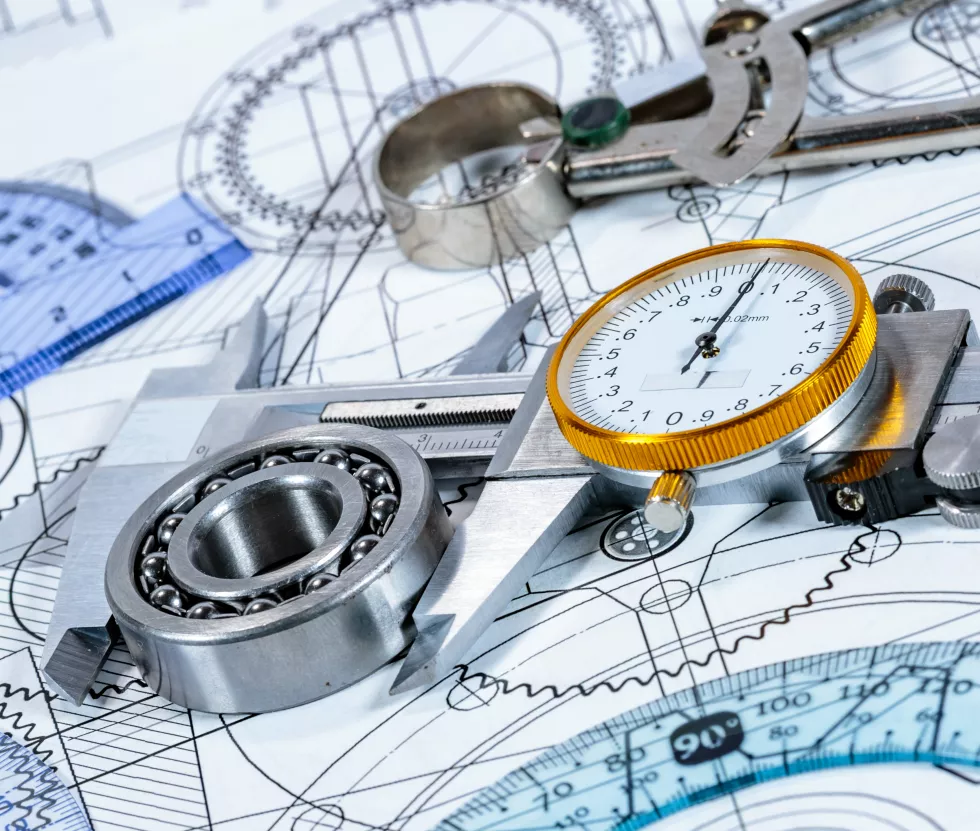
⇑Test: check whether Mechanical Engineering is the right major for you!

technical-drawing-tools

1. Do you enjoy understanding how machines and physical systems function and interact?

2. Are you interested in applying principles of dynamics, mechanics, and thermodynamics to solve engineering problems?

3. Do you enjoy designing parts or systems, including using CAD tools and iterating prototypes?

4. Are you drawn to manufacturing, material selection, and understanding how products are made?

5. Do you like solving multi-step problems that combine analysis, modeling, and practical constraints?

6. Are you interested in energy systems, heat transfer, or fluid mechanics?

7. Do you value precision, testing, and verifying that designs perform as expected?

8. Are you comfortable working in teams to bring a mechanical product from concept to reality?

9. Are you interested in incorporating automation, control, or smart systems into mechanical designs?

10. Do you care about sustainable design, efficiency, and reducing environmental impact in engineering?

⇑Definitions and quotes

Engineering
Engineering is the creative application of science, mathematical methods, and empirical evidence to the innovation, design, construction, operation and maintenance of structures, machines, materials, devices, systems, processes, and organizations. The discipline of engineering encompasses a broad range of more specialized fields of engineering, each with a more specific emphasis on particular areas of applied mathematics, applied science, and types of application. See glossary of engineering.
Mechanical Engineering
Mechanical engineering is the discipline that applies engineering, physics, engineering mathematics, and materials science principles to design, analyze, manufacture, and maintain mechanical systems. It is one of the oldest and broadest of the engineering disciplines.
Mechanical Engineering
Engineering is no longer just an industrial discipline or technology — it is also a concept of statesmanship and of humanitarianism and a challenge worthy of our best. Mechanical Engineering is a career which follows a never-setting sun.
: The Journal of the American Society of Mechanical Engineers (1963) Vol 85. p. 93
Mechanical Engineering
The field of mechanical engineering is frankly as old as human life itself. Fire, the wheel, the printing press, and many of the life- changing discoveries and inventions of the past few centuries are simply applications of mechanical engineering in order to solve everyday problems.
‎Dr. Vook Ph.D and Charles River Editors (2011) Mechanical Engineering 101: The TextVook
Mechanical Engineering
The work before us is a proof that the doctrine of mechanics is of the utmost importance to mankind in general, and to civil society in particular, which could hardly subsist without it.
The author of this work is Mr. W. Emerson who is well known in the literary world, from several ingenious writings with which he has obliged the public; some of which have passed under our consideration since the commencement of the Review. In this treatise Mr. Emerson has laid down the fundamental principles both of theory and practice, and demonstrated most of them from the common elementary geometry, and the rest from the common rules of algebra; which is certainly the best method of rendering a treatise of this kind useful to the generality of readers, the fluxionary calculus being too difficult for them to understand.
The work is divided into thirteen sections: the 1st. contains the general laws of motion. 2. The laws of gravity, the descent of heavy bodies, and the motion of projectiles. 3. The properties of the mechanical powers; the balance, the leaver, the wheel, the pulley, the screw, and the wedge. 4. The descent of bodies upon inclined planes, and in curve surfaces; and the motion of pendulums. 5. The center of gravity, and its properties. 6. The centers of percussion, oscillation, and gyration. 7. The quantity and direction of the pressure of beams of timber, by their weight; and the forces necessary to sustain them. 8. The strength of beams of timber in all positions; and their stress by any weight acting upon them, or by any forces applied to them. 9. The properties of fluids, the principles of hydrostatics, hydraulics, and pneumatics, 10. The resistance of fluids, their forces and actions upon bodies; the motions of ships, and the positions of their fails. 11. Methods of communicating, directing, and regulating any motion in the practice of mechanics. 12. The powers and properties of compound engines; of forces acting within the machines; and concerning friction. 13. The description of compound machines or engines, and the methods of computing their powers or forces; with some account as the advantages or disadvantages of their construction.
Ralph Griffiths, ‎George Edward Griffiths (1754) The Monthly Review. Vol 11. p. 490-491

Contact:

30 Mickiewicza Av.
30-059 Krakow
Centre for International Students

Regular studies
P: +48 12 617 50 92
P: +48 12 617 46 15
F: +48 12 617 52 39
E: international.students@agh.edu.pl

Exchange programmes
P: +48 12 617 52 37
P: +48 12 617 52 38
F: +48 12 617 52 39
E: exchange@agh.edu.pl
StudentNews Group Websites for students and future students — in Poland since 2007, across Europe since 2014. Over 50 websites and millions of users a year (Google Analytics). Studies in Europe Universities in Europe Bachelor’s Master’s Doctorate MBA Study guide Work abroad Travel For partners Advertising and cooperation Reach (online report) Contact advertising@studentnews.eu © 2003–2026 Grupa StudentNews.pl sp. z o.o., Modlnica, Poland
Privacy Policy