
Cracow, Poland

Geology of Natural Resources

Bachelor's
Table of contents
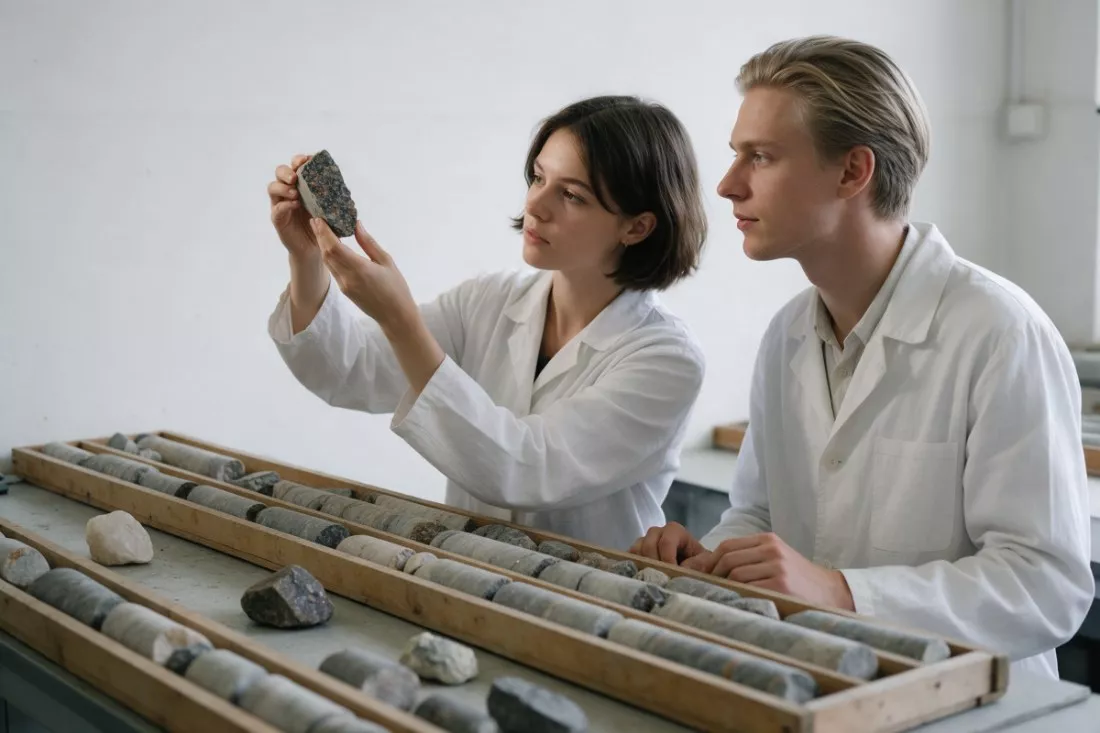
studenci-geologii-ogladaja-rdzenie-wiertnicze-w-laboratorium

⇑Geology of Natural Resources at AGH

Language: EnglishStudies in English
Subject area: physical science, environment
Kind of studies: full-time studies

⇑Why study Geology of Natural Resources at AGH?

dlaczego-warto-studiowac-na-AGH
Why study it:

Geology of Natural Resources at AGH University of Krakow is a first-cycle programme run by the Faculty of Geology, Geophysics and Environmental Protection, built around the role of raw materials in the digital transformation, the energy transition and the Critical Raw Materials challenge. It is for people interested in geology, the use of mineral resources, modern technologies and the sustainable management of natural resources.

Programme: classical Earth sciences meet modern exploration

The curriculum combines the foundations of Earth sciences with topics such as:

  • mineral exploration and the evaluation of the resource potential of geological targets
  • geochemistry and geophysics
  • Geographic Information Systems (GIS)
  • geological data analysis and modelling
  • the environmental impact of mining, recycling of mining waste and circular economy principles

Labs: laboratory, project and field classes

Laboratory, project and field classes are an integral part of the programme and use the Faculty’s research infrastructure, following recognised procedures and standards of contemporary Earth sciences. You learn to plan and carry out geological works, take samples, run laboratory analyses and interpret the data. You also work with digital tools and specialised software widely used in the raw materials sector.

After graduation: across the raw materials sector

Graduates can identify and assess mineral deposits, model geological data and apply GIS tools in exploration and documentation. They are prepared to work in the raw materials industry – from prospecting and mineral exploration, through mining enterprises, to research institutions, consulting companies and public administration.

This includes the area of critical and strategic raw materials, which play a key role in the development of a modern economy.

Did you know? The curriculum also deals with integrating environmental, economic and social factors in the management of natural resources.

As of the 2026/27 admissions, based on the programme page at rekrutacja.agh.edu.pl.
⇑Test: Is Geology of Natural Resources the right fit for you?

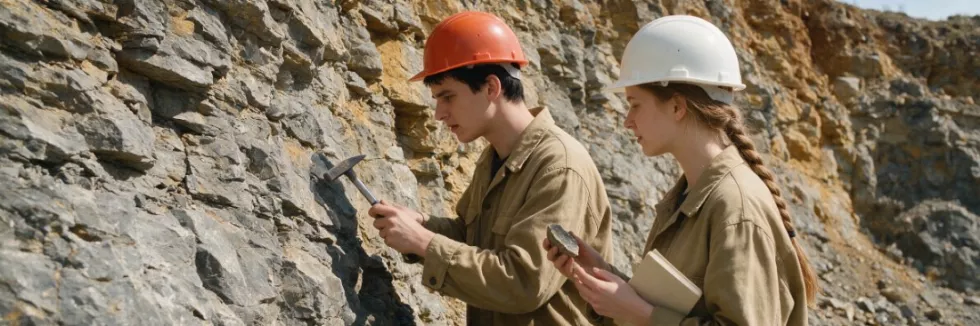
geology-students-examining-a-rock-face-in-a-quarry

10 questions · two minutes

1. On a trip to the mountains, you notice bands of different colours in a rock face. What do you do?

2. How do you get on with chemistry and physics at school?

3. Have you ever wondered where the metals in your phone come from?

4. Lectures, textbooks and fieldwork reports will be in English, and you’ll study in an international group. How does that sound?

5. Studying geology means plenty of days in the field – in quarries, at rock outcrops, sometimes in the rain. How do you feel about that?

6. You’re given a map with contour lines and different rock types marked on it. How do you react?

7. Your class is debating the raw materials needed for batteries and wind turbines. What’s your take?

8. You have the chance to visit a mineral museum or an old mine. Which do you choose?

9. What do you picture yourself doing in the future?

10. What motivates you most to study Geology of Natural Resources?

⇑Definitions and quotes

Geology
Geology (from the Ancient Greek γῆ, gē, i.e. "earth" and -λoγία, -logia, i.e. "study of, discourse") is an earth science concerned with the solid Earth, the rocks of which it is composed, and the processes by which they change over time. Geology can also refer to the study of the solid features of any terrestrial planet or natural satellite, (such as Mars or the Moon).
Natural Resources
Natural Resources is a soul album released by Motown girl group Martha Reeves and the Vandellas in 1970 on the Gordy (Motown) label. The album is significant for the Vietnam War ballad "I Should Be Proud" and the slow jam, "Love Guess Who". The album marked a return from lead singer Martha Reeves, recovering from a time in a mental institution after an addiction to painkillers nearly wrecked her (though it still took her until 1977 to beat her addiction). This was the next-to-last album for the Vandellas, whose success had peaked in the mid-1960s.
Geology
Geological facts being of an historical nature, all attempts to deduce a complete knowledge of them merely from their still, subsisting consequences, to the exclusion of unexceptionable testimony, must be deemed as absurd as that of deducing the history of ancient Rome solely from the medals or other monuments of antiquity it still exhibits, or the scattered ruins of its empire, to the exclusion of a Livy, a Sallust, or a Tacitus.
Richard Kirwan in: The Transactions of the Royal Irish Academy, Volume 6: Essay on the Primitive State of the Globe and its Subsequent Catastrophe, Royal Irish Academy (Dublin), 1797, p. 236
Geology
Geology is rapidly taking its place as an introduction to the higher history of man. If the author has sought to exalt a favorite science, it has been with the desire that man—in whom geological history had its consummation, the prophecies of the successive ages their fulfilment—might better comprehend his own nobility and the true purpose of his existence.
James D. Dana in: Geology: Treating Of The Principles Of The Science With Special Reference To American Geological History, For The Use Of Colleges, Academies, And Schools Of Science., Theodore Bliss & Co., London: Trubner A Co., 1863, in Preface p. ix.
Geology
GEOLOGY, n. The science of the earth's crust —to which, doubtless, will be added that of its interior whenever a man shall come up garrulous out of a well. The geological formations of the globe already noted are catalogued thus: The Primary, or lower one, consists of rocks, bones of mired mules, gas-pipes, miners' tools, antique statues minus the nose, Spanish doubloons and ancestors. The Secondary is largely made up of red worms and moles. The Tertiary comprises railway tracks, patent pavements, grass, snakes, mouldy boots, beer bottles, tomato cans, intoxicated citizens, garbage, anarchists, snap-dogs and fools.
Ambrose Bierce in:The Devil's Dictionary of Ambrose Bierce - Complete and Unabridged - Special Edition, Special Edition Books, 2010, p. 67.

Contact:

30 Mickiewicza Av.
30-059 Krakow
Centre for International Students

Regular studies
P: +48 12 617 50 92
P: +48 12 617 46 15
F: +48 12 617 52 39
E: international.students@agh.edu.pl

Exchange programmes
P: +48 12 617 52 37
P: +48 12 617 52 38
F: +48 12 617 52 39
E: exchange@agh.edu.pl
Privacy Policy