


Cracow, Poland

Energy and Environmental Engineering

Master's
Table of contents
wind-farms-fields

⇑Energy and Environmental Engineering at AGH

Language: EnglishStudies in English
Subject area: engineering and engineering trades
Kind of studies: full-time studies
  • Description:

  • pl

⇑Why study Energy and Environmental Engineering (Master's) at AGH?

dlaczego-warto-studiowac-na-AGH
Why study it:

Energy and Environmental Engineering at AGH University of Krakow is a second-cycle (Master's) programme built around the interdisciplinary nature of modern energy systems. It is for engineers who want to model, design and assess systems for energy conversion, storage and distribution, with environmental impact and energy security in mind.

Programme: advanced energy systems and numerical modelling

The programme covers, among other things:

  • thermodynamics, heat and mass transfer, fluid mechanics and advanced mechanics
  • mathematical modelling, numerical methods for analysing energy systems, and CAD/CAM
  • renewable energy systems, bioenergy, recovering useful energy from waste energy, and smart grids
  • energy storage and conversion, energy efficiency and low-emission combustion
  • life cycle assessment of technologies, patents, standards and regulations in system design
  • the economic framework of running and managing a business

Specialisation: an individual research plan

The programme focuses on individualised teaching: most of your work follows an individual research plan, often with the support of tutors.

Labs: laboratory and semi-technical scale experiments

You learn to plan and run experiments on a laboratory and semi-technical scale, operate sensors, and formulate and test hypotheses. Results are analysed with attention to measurement errors and uncertainty. You also monitor, control and diagnose devices, and use information and communication technologies to solve nonlinear problems with approximate methods.

Placements: a four-week diploma placement

A 4-week diploma placement is part of the study plan of this Master's programme.

Exchanges: a semester in Tokyo

In the third semester, AGH students can take part in a semester internship at the Shibaura Institute of Technology in Tokyo. The programme also develops intercultural communication and the ability to discuss advanced energy and environmental problems in a foreign language.

After graduation: energy infrastructure, hydrogen, consulting

Graduates can work as specialists in computer modelling of power-industry processes, in fuel cells and hydrogen technologies, and in the design, construction and operation of energy infrastructure – as designers of energy machines and installations, supervisory engineers, energy assessment specialists or energy consultants.

Possible employers include domestic and foreign energy companies, design offices, research laboratories and universities, and public bodies dealing with energy policy, security and environmental protection. You can also start your own business in renewables or computer simulation.

As of the 2026/27 admissions, based on the programme page at rekrutacja.agh.edu.pl.
more on the website:
www.e3.agh.edu.pl

⇑Test: check whether Energy and Environmental Engineering is the right major for you!

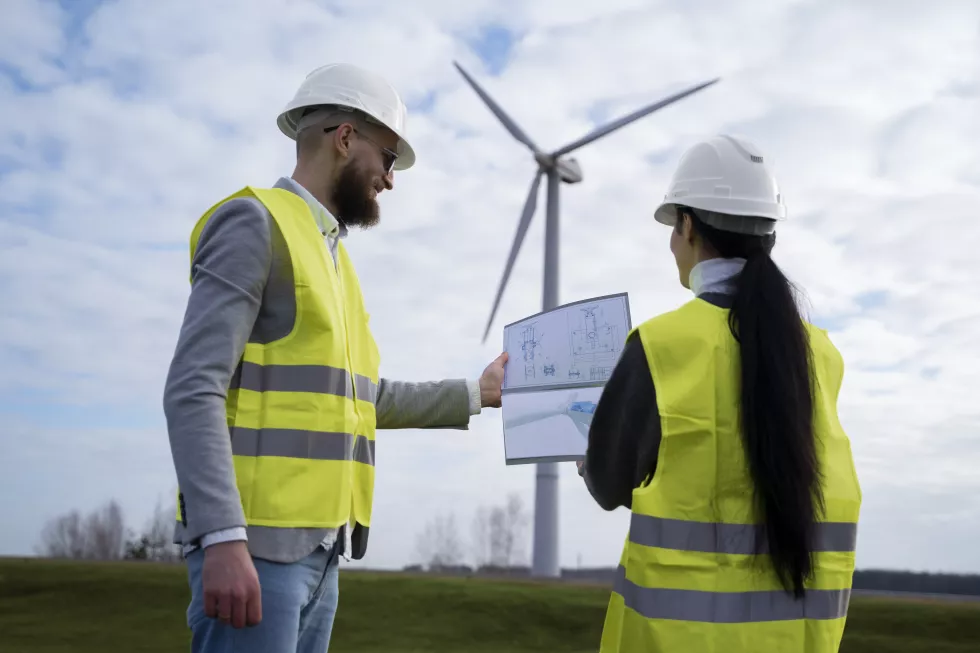
medium-shot-engineers-discussing-environmental-plan

Answer all questions to see if Energy and Environmental Engineering (Master's) is the right fit for you!

1. Are you motivated to integrate energy systems with environmental protection and sustainability?

2. Do you want to work on designing low-impact energy systems and reducing environmental footprints?

3. Are you interested in renewable energy, waste-to-energy, and resource recovery technologies?

4. Are you willing to engage in multidisciplinary research combining engineering, ecology, and policy?

5. Do you believe a two-year master’s degree will significantly improve your ability to solve complex energy-environment challenges?

6. Are you interested in modelling, monitoring, and optimizing energy flows with environmental constraints?

7. Do you want to build competence in environmental regulations, lifecycle assessment, and sustainability metrics for energy projects?

8. Are you motivated to work on smart systems that manage energy while preserving ecosystems (e.g., smart grids with ecological awareness)?

9. Are you prepared to collaborate with environmental scientists, policy makers, and engineers to deliver holistic solutions?

10. What motivates you most to pursue a master’s in Energy and Environmental Engineering?

more on the website:
www.e3.agh.edu.pl

⇑Definitions and quotes

Energy
In physics, energy is the quantitative property that must be transferred to an object in order to perform work on, or to heat, the object. Energy is a conserved quantity; the law of conservation of energy states that energy can be converted in form, but not created or destroyed. The SI unit of energy is the joule, which is the energy transferred to an object by the work of moving it a distance of 1 metre against a force of 1 newton.
Engineering
Engineering is the creative application of science, mathematical methods, and empirical evidence to the innovation, design, construction, operation and maintenance of structures, machines, materials, devices, systems, processes, and organizations. The discipline of engineering encompasses a broad range of more specialized fields of engineering, each with a more specific emphasis on particular areas of applied mathematics, applied science, and types of application. See glossary of engineering.
Energy
E = mc²
Albert Einstein, The equivalence of matter and energy was originally expressed by the equation m = L/c², which easily translates into the far more well known E = mc² in Does the Inertia of a Body Depend Upon Its Energy Content? published in the Annalen der Physik (27 September 1905) : "If a body gives off the energy L in the form of radiation, its mass diminishes by L/c²."
Engineering
When I looked at the science of engineering and saw that it had disappeared after its ancient heritage, that its masters have perished, and that their memories are now forgotten, I worked my wits and thoughts in secrecy about philosophical shapes and figures, which could move the mind, with effort, from nothingness to being and from idleness to motion. And I arranged these shapes one by one in drawings and explained them
Al-Muradi, The Book of Secrets in the Results of Ideas, 11th century; Translated and cited at leonardo3.net/bookofsecrets/index, 2015
Engineering
Engineering is the art of directing the great sources of power in nature for the use and convenience of man.
Thomas Tredgold (1828), used in the Royal Charter of the Institution of Civil Engineers (ICE) published in: The Times, London, article CS102127326, 30 June 1828.
more on the website:
www.e3.agh.edu.pl

Contact:

30 Mickiewicza Av.
30-059 Krakow
Centre for International Students

Regular studies
P: +48 12 617 50 92
P: +48 12 617 46 15
F: +48 12 617 52 39
E: international.students@agh.edu.pl

Exchange programmes
P: +48 12 617 52 37
P: +48 12 617 52 38
F: +48 12 617 52 39
E: exchange@agh.edu.pl
Privacy Policy