Energy
In physics, energy is the quantitative property that must be transferred to an object in order to perform work on, or to heat, the object. Energy is a conserved quantity; the law of conservation of energy states that energy can be converted in form, but not created or destroyed. The SI unit of energy is the joule, which is the energy transferred to an object by the work of moving it a distance of 1 metre against a force of 1 newton.
Energy Engineering
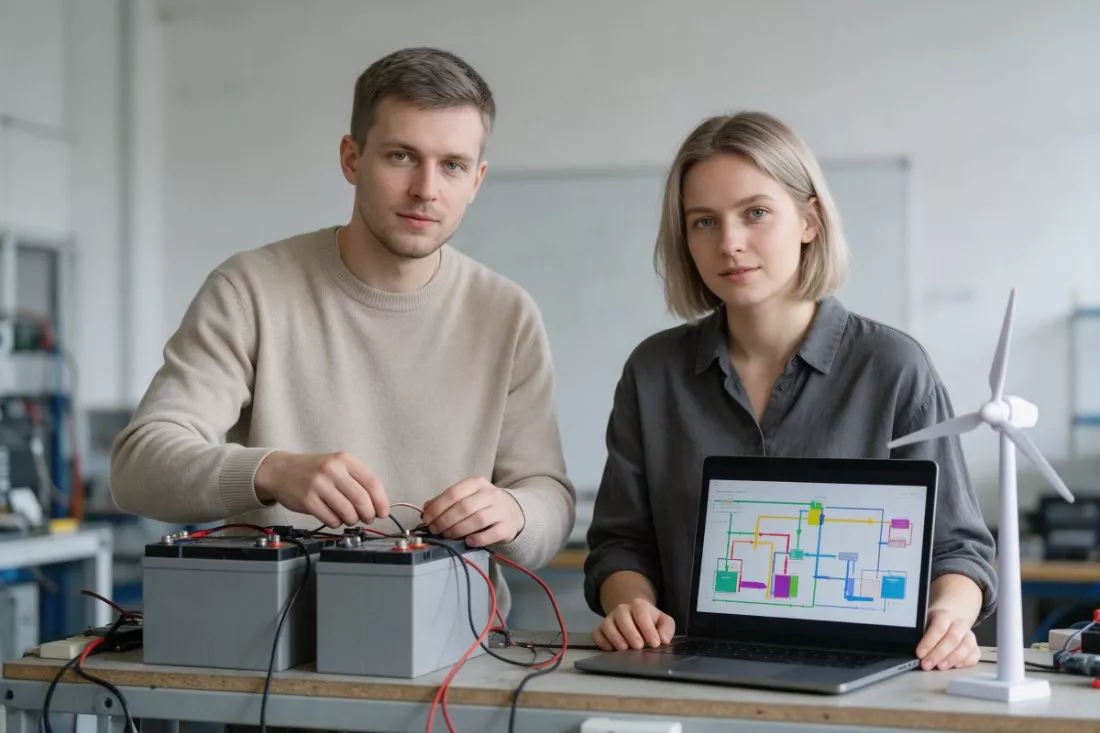
Energy engineering or energy systems engineering is a broad field of engineering dealing with energy efficiency, energy services, facility management, plant engineering, environmental compliance and alternative energy technologies. Energy engineering is one of the more recent engineering disciplines to emerge. Energy engineering combines knowledge from the fields of physics, math, and chemistry with economic and environmental engineering practices. Energy engineers apply their skills to increase efficiency and further develop renewable sources of energy. The main job of energy engineers is to find the most efficient and sustainable ways to operate buildings and manufacturing processes. Energy engineers audit the use of energy in those processes and suggest ways to improve the systems. This means suggesting advanced lighting, better insulation, more efficient heating and cooling properties of buildings. Although an energy engineer is concerned about obtaining and using energy in the most environmentally friendly ways, their field is not limited to strictly renewable energy like hydro, solar, biomass, or geothermal. Energy engineers are also employed by the fields of oil and natural gas extraction.
Engineering
Engineering is the creative application of science, mathematical methods, and empirical evidence to the innovation, design, construction, operation and maintenance of structures, machines, materials, devices, systems, processes, and organizations. The discipline of engineering encompasses a broad range of more specialized fields of engineering, each with a more specific emphasis on particular areas of applied mathematics, applied science, and types of application. See glossary of engineering.
Renewable Energy
Renewable energy is energy that is collected from renewable resources, which are naturally replenished on a human timescale, such as sunlight, wind, rain, tides, waves, and geothermal heat. Renewable energy often provides energy in four important areas: electricity generation, air and water heating/cooling, transportation, and rural (off-grid) energy services.
Energy
Our decision about energy will test the character of the American people and the ability of the President and the Congress to govern this Nation. This difficult effort will be the "moral equivalent of war," except that we will be uniting our efforts to build and not to destroy.
Jimmy Carter, address to the nation on the energy problem (April 18, 1977); Public Papers of the Presidents of the United States: Jimmy Carter, 1977, book 1, p. 656. Carter was quoting William James, who used the phrase in his essay, "The Moral Equivalent of War".
Engineering
Engineering is the conscious application of science to the problem of economic production.
Halbert Powers Gillette (1910). cited in: T.J. Hoover & J.C. Lounsbury Fish. The Engineering Profession. Stanford University Press, 1941. p. 463
Engineering
These experiences are not 'religious' in the ordinary sense. They are natural, and can be studied naturally. They are not 'ineffable' in the sense the sense of incommunicable by language. Maslow also came to believe that they are far commoner than one might expect, that many people tend to suppress them, to ignore them, and certain people seem actually afraid of them, as if they were somehow feminine, illogical, dangerous. 'One sees such attitudes more often in engineers, in mathematicians, in analytic philosophers, in book keepers and accountants, and generally in obsessional people'.
The peak experience tends to be a kind of bubbling-over of delight, a moment of pure happiness. 'For instance, a young mother scurrying around her kitchen and getting breakfast for her husband and young children. The sun was streaming in, the children clean and nicely dressed, were chattering as they ate. The husband was casually playing with the children: but as she looked at them she was suddenly so overwhelmed with their beauty and her great love for them, and her feeling of good fortune, that she went into a peak experience . . .
Colin Wilson in New Pathways In Psychology, p. 17





 EN

 CS
 DE
 ES
 FR
 HU
 IT
 PL
 PT
 РУ
 SK
 TR
 УК
 AR
 中文