
Częstochowa, Poland

Stage music
(field of studies: Music in Public Space)

Bachelor's
Table of contents
stage-before

⇑Stage music at UJD

Field of studies: Music in Public Space
Language: EnglishStudies in English
Subject area: arts
Kind of studies: full-time studies
  • Description:

  • pl
University website: www.en.ujd.edu.pl

⇑Why choose the Stage music specialisation at UJD?

Dlaczego warto studiować na UJD
Why study it:

Stage music is a specialisation within the Music in Public Space programme (first-cycle studies) at Jan Długosz University in Częstochowa. You choose it if you want to sing or play electric guitar, bass guitar or drums and perform popular and jazz-flavoured music in different ensembles.

Programme: the jazz toolkit

Apart from general music preparation, this path teaches you the language of jazz. Courses in the specialist block cover rudiments of jazz harmony, with chord structures, the II-V-I cadence, turnarounds and substitutes, as well as rudiments of jazz improvisation in styles such as blues, swing, be-bop, latin-jazz and funk. You also learn jazz arrangement, which means setting chosen themes for a given ensemble while keeping the style of the genre.

Specialisation: your own voice or instrument

You pick one specialisation and develop it throughout the studies:

  • vocal studies;
  • electric guitar;
  • bass guitar;
  • drum set.

Labs: ensembles and the stage

A large part of the work happens in groups. You sing in vocal ensembles and take part in vocal-instrumental ensembles, and you can choose a jazz combo or text interpretation with diction. Stage movement and dance with choreographic elements, together with basic piano and conducting skills, prepare you to build your own creative performances. A history of jazz and popular music, from blues and soul to rock, hip-hop and pop, gives the whole thing context.

Languages: studying in English

The programme is taught in English, so you work on harmony, improvisation and arrangement in that language.

After graduation: what you are ready for

You are able to perform a varied vocal and instrumental repertoire in the right performance style and to work with other musicians in vocal, instrumental and vocal-instrumental line-ups.

After the bachelor of arts degree you can continue on to second-cycle studies.

Based on the study plan and the UJD admissions page.

Updated: 11.11.2026
⇑Test: Is Stage music the right fit for you?

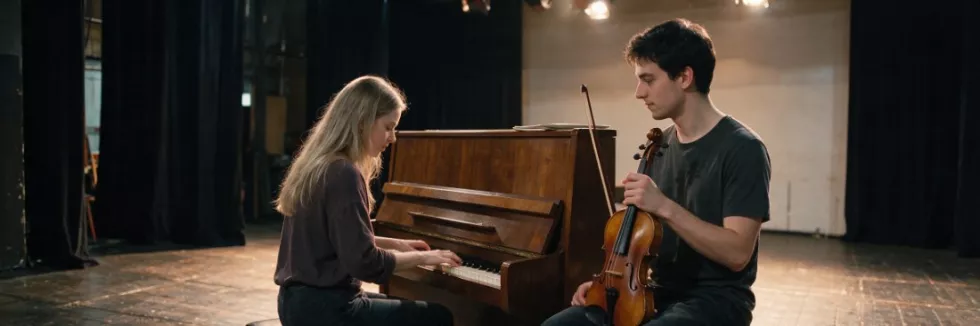
music-students-rehearsing-piano-and-violin-on-a-theatre-stage

10 questions · two minutes

1. A director asks you to compose a short piece that builds tension before a key scene in a play. How do you feel?

2. How do you feel about long rehearsals, repeating the same scene until the music fits the actors’ movements?

3. When you watch a musical or a play, what do you notice?

4. How do you feel about learning harmony, orchestration and music theory in depth?

5. During a live show an actor skips several lines while you’re playing the accompaniment. What do you do?

6. Which project would you choose?

7. The programme is taught in English, and you’ll create performances with students from many countries. How do you feel about that?

8. How do you feel about working closely with directors, choreographers and sound engineers and taking their feedback?

9. Which future role sounds most like you?

10. What motivates you most to study Stage music?

⇑Definitions and quotes

Music
Music is an art form and cultural activity whose medium is sound organized in time. The common elements of music are pitch (which governs melody and harmony), rhythm (and its associated concepts tempo, meter, and articulation), dynamics (loudness and softness), and the sonic qualities of timbre and texture (which are sometimes termed the "color" of a musical sound). Different styles or types of music may emphasize, de-emphasize or omit some of these elements. Music is performed with a vast range of instruments and vocal techniques ranging from singing to rapping; there are solely instrumental pieces, solely vocal pieces (such as songs without instrumental accompaniment) and pieces that combine singing and instruments. The word derives from Greek μουσική (mousike; "art of the Muses"). See glossary of musical terminology.
Music
In hollow murmurs died away.
William Collins, The Passions, an Ode for Music (1747), line 68.
Music
Writ in the climate of heaven, in the language spoken by angels.
Henry Wadsworth Longfellow, The Children of the Lord's Supper, line 262.
Music
We get nearer to the Lord through music than perhaps through any other thing except prayer.
J. Reuben Clark, LDS Conference Report, Oct. 1936.

Contact:

Waszyngtona str. 4/8
42-200 Częstochowa
phone +48 34 378 41 00
StudentNews Group Websites for students and future students — in Poland since 2007, across Europe since 2014. Over 50 websites and millions of users a year (Google Analytics). Studies in Europe Universities in Europe Bachelor’s Master’s Doctorate MBA Study guide Work abroad Travel For partners Advertising and cooperation Reach (online report) Contact advertising@studentnews.eu © 2003–2026 Grupa StudentNews.pl sp. z o.o., Modlnica, Poland
Privacy Policy