Bydgoszcz, Poland

Mechatronics of Production Systems
(field of studies: Mechatronics)

Bachelor's - engineer
Table of contents
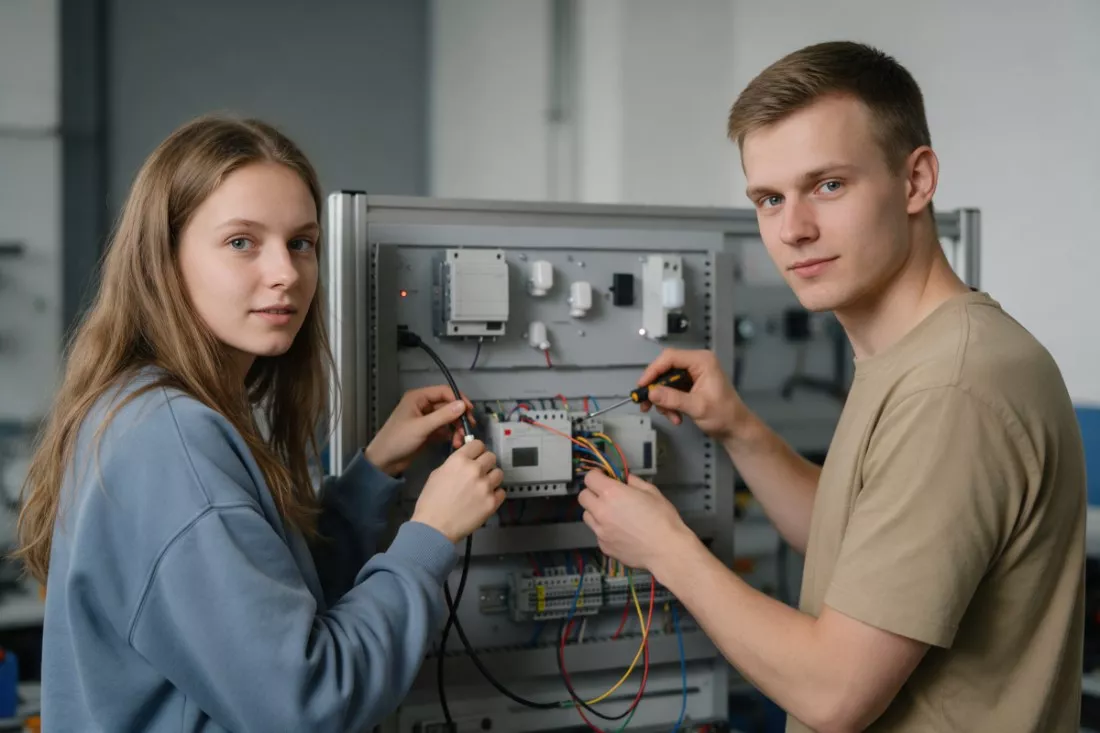
studenci-mechatroniki-podlaczaja-czujniki-do-panelu-sterowania

⇑Mechatronics of Production Systems at UKW

Field of studies: Mechatronics
Language: EnglishStudies in English
Subject area: engineering and engineering trades
Kind of studies: full-time studies
University website: www.ukw.edu.pl/strona/english

⇑Test: Is Mechatronics of Production Systems the right fit for you?

students-programming-a-white-robot-arm-at-a-conveyor

10 questions · two minutes

1. You’re watching a video of a production line where robots and conveyors assemble products on their own. What interests you?

2. Have you ever built anything with a microcontroller, sensors or small motors?

3. In your summer job you repeat the same packing task every day. What goes through your mind?

4. Which subjects do you enjoy most at school?

5. Classes, labs and equipment documentation will all be in English, and you’ll be studying with students from different countries. How does that sound?

6. Your electronic circuit isn’t working. How do you track down the fault?

7. You have to build a model barrier that lifts when a car pulls up. What do you take on?

8. Someone says automation is taking people’s jobs. How do you respond?

9. Where do you see yourself after graduating?

10. What motivates you most to study Mechatronics of Production Systems?

⇑Definitions and quotes

Mechatronics
Mechatronics is a multidisciplinary field of science that includes a combination of mechanical engineering, electronics, computer engineering, telecommunications engineering, systems engineering and control engineering. As technology advances, the subfields of engineering multiply and adapt. Mechatronics' aim is a design process that unifies these subfields. Originally, mechatronics just included the combination of mechanics and electronics, therefore the word is a combination of mechanics and electronics; however, as technical systems have become more and more complex the definition has been broadened to include more technical areas.
Production
Part of the goods which are annually produced, and which are called wealth, is, strictly speaking, waste, because it consists of articles which ... either should not have been produced until other articles had already been produced in sufficient abundance, or should not have been produced at all. And some part of the population is employed in making goods which no man can make with happiness, or indeed without loss of self-respect, because he knows that they had much better not be made; and that his life is wasted in making them.
R. H. Tawney, The Acquisitive Society (1920), pp. 37–38.
Production
The product of mental labor — science — always stands far below its value, because the labor-time necessary to reproduce it has no relation at all to the labor-time required for its original production.
Karl Marx Addenda, "Relative and Absolute Surplus Value" in Economic Manuscripts (1861–63).
Production
Production systems which are technologically the most advanced are also the least adaptable and work to the longest time scale of decision making. These are the process industries (chemical plants, oil refineries and so on) in which vast resources are invested in the creation of a closely programmed and tightly controlled process which will continue to perform the same task over a very long period.
Joan Woodward (1965, 1970), as cited in: Romiszowski, A. J. (2016). Designing Instructional Systems: Decision Making in Course Planning ..., p. 13

Contact:

J. K. Chodkiewicza 30 street
85-064 Bydgoszcz
phone: (48 52) 341 91 08
Fax: (48 52) 341 91 07
Privacy Policy