


Poznań, Poland

Transition, Innovation and Sustainability Environments

Master's
Table of contents
mlodzi-ludzie-naprawiaja-krzeslo-i-kolo-rowerowe-w-warsztacie

⇑Transition, Innovation and Sustainability Environments at UEP

Language: EnglishStudies in English
Subject area: economy and administration
Kind of studies: full-time studies
University website: http://ue.poznan.pl/en/

⇑Why study Transition, Innovation and Sustainability Environments at PUEB?

dlaczego-warto-studiowac-na-UEP
Why study it:

Transition, Innovation and Sustainability Environments (TISE) at the Poznań University of Economics and Business (PUEB) is a full-time Master's (second-cycle) programme taught in English, conducted jointly by four European universities within the field of International Economics. It is for those interested in social systems in transformation and in developing strategies for the sustainable development of the global economy.

Programme: social systems in transformation

You learn how social systems work and change – their dynamics and interactions in science, technology, ethics and economics. The programme takes a holistic, transdisciplinary approach to social and economic problems and uses a wide range of instruments to analyse them. Strong emphasis is put on applying what you learn, cooperation with business practice and innovative teaching methods.

Exchanges: one semester in each of four countries

You spend one semester at each of the four universities that run the programme and graduate with their joint diploma:

  • Donau-Universität Krems (Austria),
  • Universidade Nova de Lisboa (Portugal),
  • University College Dublin (Ireland),
  • PUEB (Poland).

After graduation: business, consulting and research

The programme's job profile includes company owner, managing director, organisational development specialist, market analyst, consultant, researcher, teacher and social work specialist.

As of the 2026/27 admissions, based on the programme descriptions at ue.poznan.pl.
⇑Test: Is Transition, Innovation and Sustainability Environments the right fit for you?

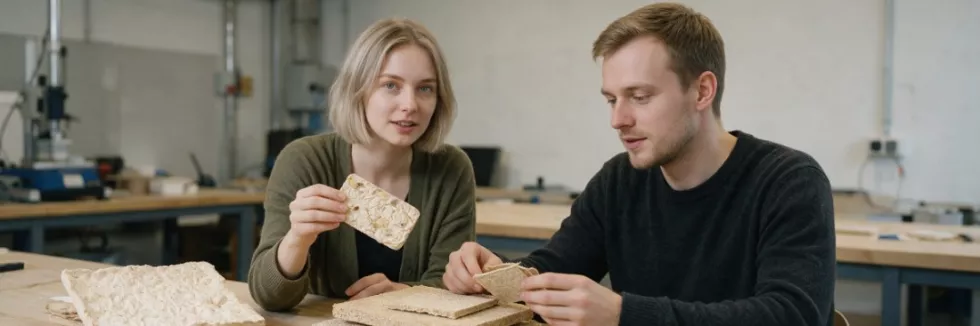
two-researchers-examining-sustainable-material-samples

10 questions · two minutes

1. At the company where you’re doing an internship, the board wants to ‘go green’ but doesn’t know where to start. What do you suggest?

2. A city introduces a low-traffic zone and some residents protest. How do you see the situation?

3. A start-up claims its technology will ‘solve the plastic problem’. How do you assess it?

4. Seminars, case studies and team projects will all be in English, in a group of people from many different countries. How does that sound?

5. You’re running a workshop for residents, officials and local businesses on the future of a neighbourhood. Every group wants something different. What do you do?

6. You have to assess whether a community gardens programme has actually made a difference. How do you go about it?

7. You hear about a business model based on repair and rental rather than sales. What do you think?

8. A new climate strategy is published for your region. What do you do?

9. Where do you see yourself after graduating?

10. What motivates you most to pursue a Master’s degree in Transition, Innovation and Sustainability Environments?

⇑Definitions and quotes

Innovation
Innovation can be defined simply as a "new idea, device or method". However, innovation is often also viewed as the application of better solutions that meet new requirements, unarticulated needs, or existing market needs. Such innovation takes place through the provision of more-effective products, processes, services, technologies, or business models that are made available to markets, governments and society. The term "innovation" can be defined as something original and more effective and, as a consequence, new, that "breaks into" the market or society. Innovation is related to, but not the same as, invention, as innovation is more apt to involve the practical implementation of an invention (i.e. new/improved ability) to make a meaningful impact in the market or society, and not all innovations require an invention. Innovation often manifests itself via the engineering process, when the problem being solved is of a technical or scientific nature. The opposite of innovation is exnovation.
Sustainability
Sustainability (from 'sustain' and 'ability') is the process of change, in which the exploitation of resources, the direction of investments, the orientation of technological development and institutional change are all in harmony and enhance both current and future potential to meet human needs and aspirations. The organizing principle for sustainability is sustainable development, which includes the following interconnected domains: environment, economic and social. Sub-domains of sustainable development have been considered also: cultural, technological and political. Sustainable development, is the development that meets the needs of the present without compromising the ability of future generations to meet their own needs. Brundtland Report for the World Commission on Environment and Development (1992) introduced the term of sustainable development.
Sustainability
The new paradigm may be called a holistic world view, seeing the world as an integrated whole rather than a dissociated collection of parts. It may also be called an ecological view, if the term "ecological" is used in a much broader and deeper sense than usual. Deep ecological awareness recognizes the fundamental interdependence of all phenomena and the fact that, as individuals and societies we are all embedded in (and ultimately dependent on) the cyclical process of nature.
Fritjof Capra, Gunter A. Pauli (1995) Steering Business Toward Sustainability. p. 3 cited in: Elmer Kennedy-Andrews (2008) Writing Home. p. 13.
Innovation
As the births of living creatures at first are ill-shapen, so are all Innovations, which are the births of time.
Francis Bacon, ‘Of Innovations’, Essays, 24.
Innovation
Innovation is more than having new ideas: it includes the process of successfully introducing them or making things happen in a new way. It turns ideas into useful, practicable and commercial products or services.
John Adair (b.1934), British author, writer on business leadership. ‘Taking good ideas to market’, Ch 11, Effective Innovation (2009), revised edition.

Contact:

al. Niepodległości 10
61-875 Poznań, Poland
phone: +48 61 856 90 00
Privacy Policy