Warsaw, Poland

European Environmental Economics and Policy

Master's
Table of contents

⇑European Environmental Economics and Policy at UW WNE

Language: EnglishStudies in English
Subject area: physical science, environment
Kind of studies: full-time studies
  • Description:

  • pl
University website: www.wne.uw.edu.pl/en/

⇑Test: Is European Environmental Economics and Policy the right fit for you?

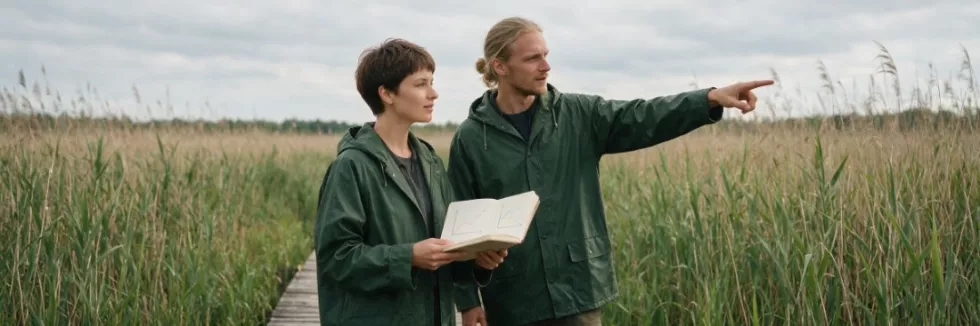
economists-discussing-a-wetland-on-a-boardwalk

10 questions · two minutes

1. Policymakers are debating a carbon tax versus an emissions trading scheme. How would you compare them?

2. You need to value a wetland’s ecosystem services for a cost-benefit analysis. How do you approach it?

3. How do you feel about using panel data econometrics to test whether a policy actually reduced emissions?

4. Higher energy prices are hitting low-income households hard. How would you design support?

5. You’re asked to write a two-page policy brief for decision-makers. How do you respond?

6. Fish stocks are collapsing because everyone overfishes a shared sea. What solution would you explore?

7. Seminars, group projects and policy simulations are in English, with students from many countries. How does that sound?

8. A large environmental subsidy programme has spent a lot, but its results are unclear. What do you do?

9. Which future role sounds most like you?

10. What motivates you most to pursue a Master’s degree in European Environmental Economics and Policy?

⇑Definitions and quotes

Economics
Economics () is the social science that studies the production, distribution, and consumption of goods and services.
Policy
A policy is a deliberate system of principles to guide decisions and achieve rational outcomes. A policy is a statement of intent, and is implemented as a procedure or protocol. Policies are generally adopted by a governance body within an organization. Policies can assist in both subjective and objective decision making. Policies to assist in subjective decision making usually assist senior management with decisions that must be based on the relative merits of a number of factors, and as a result are often hard to test objectively, e.g. work-life balance policy. In contrast policies to assist in objective decision making are usually operational in nature and can be objectively tested, e.g. password policy.
Economics
The blunt truth about the politics of climate change is that no country will want to sacrifice its economy in order to meet this challenge.
Tony Blair, address to the 2005 G8 climate change summit in London, as reported by David Adam, "Blair signals shift over climate change", The Guardian, 1 November 2005.
Economics
Capitalism is the exploitation of man by man; Communism is the exact opposite.
Coluche, "Les syndicats et le délégué," Coluche : l'intégrale, vol. 3, "1989 chez Carrère".
Policy
Don't throw a monkey-wrench into the machinery.
Philander Chase Johnson, Everybody's Magazine (May 1920), p. 36.

Contact:

ul. Długa 44/50,
00-241 Warszawa
+48 22 55 49 126
Privacy Policy