Wrocław, Poland

Informatics in Medicine
(field of studies: Bioinformatics)

Bachelor's - engineer
Table of contents
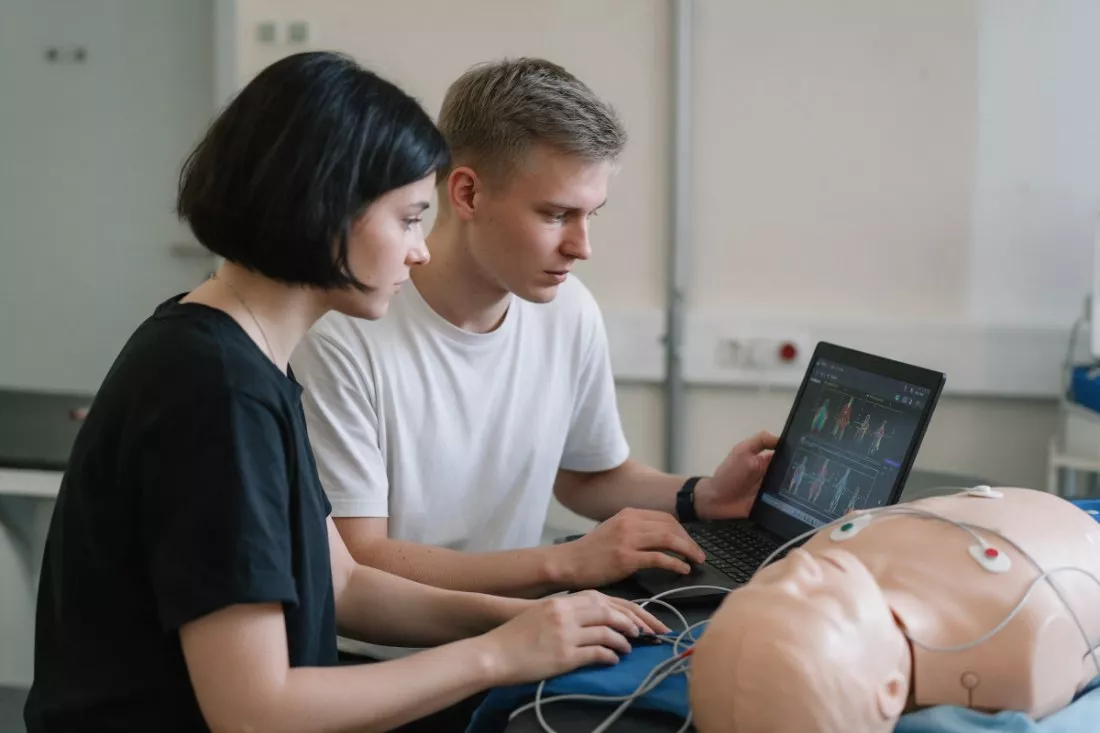
studenci-informatyki-medycznej-przy-manekinie-treningowym

⇑Informatics in Medicine at ATINS

Field of studies: Bioinformatics
Language: EnglishStudies in English
Subject area: computer science
Kind of studies: full-time studies, part-time studies
University website: atins.pl/en

⇑Test: Is Informatics in Medicine the right fit for you?

students-analysing-heart-data-on-laptops-next-to-a-heart-model

10 questions · two minutes

1. In biology you’re learning how the heart works, and your teacher shows you an ECG trace. What interests you most?

2. Have you ever done any coding?

3. How do you feel about biology and learning how the human body works?

4. Imagine you’re building an app that stores patients’ test results. What do you pay special attention to?

5. Lectures, documentation and research papers will be in English, and you’ll do projects in a group with people from many countries. How does that sound?

6. A friend wears a fitness band that tracks their heart rate and sleep. What do you make of it?

7. You hear that computer programs help doctors spot changes on X-rays. How do you react?

8. On a project, you need to find out from a doctor what she needs from a new system. How do you go about it?

9. Your program for totalling test results sometimes shows the wrong values. What do you do?

10. What motivates you most to study Informatics in Medicine?

⇑Definitions and quotes

Informatics
Informatics is a branch of information engineering. It involves the practice of information processing and the engineering of information systems, and as an academic field it is an applied form of information science. The field considers the interaction between humans and information alongside the construction of interfaces, organisations, technologies and systems. As such, the field of informatics has great breadth and encompasses many subspecialties, including disciplines of computer science, information systems, information technology and statistics. Since the advent of computers, individuals and organizations increasingly process information digitally. This has led to the study of informatics with computational, mathematical, biological, cognitive and social aspects, including study of the social impact of information technologies.
Medicine
Medicine is the science and practice of the diagnosis, treatment, and prevention of disease. Medicine encompasses a variety of health care practices evolved to maintain and restore health by the prevention and treatment of illness. Contemporary medicine applies biomedical sciences, biomedical research, genetics, and medical technology to diagnose, treat, and prevent injury and disease, typically through pharmaceuticals or surgery, but also through therapies as diverse as psychotherapy, external splints and traction, medical devices, biologics, and ionizing radiation, amongst others.
Medicine
'Tis time to give 'em physic, their diseases
Are grown so catching.
William Shakespeare, Henry VIII (c. 1613), Act I, scene 3, line 36.
Medicine
You behold in me
Only a travelling Physician;
One of the few who have a mission
To cure incurable diseases,
Or those that are called so.
Henry Wadsworth Longfellow, Christus, The Golden Legend (1872), Part I.
Medicine
Who shall decide when doctors disagree,
And soundest casuists doubt, like you and me?
Alexander Pope, Moral Essays (1731-35), Epistle III.
Privacy Policy